
July recap: the month the system earned its keep
July finished at −0.30%.
A small red month.
Also a busy one.
AMD and JPM stopped out. Semiconductors suffered their worst week since April 2025. The Dow fell 1,152 points in one session. The Federal Reserve held rates with three members preferring a hike. Four mega-cap companies reported and the market repeatedly reversed its verdict on the AI trade.
In the middle of that, I completed ten portfolio transactions: eight new positions and two additions to existing holdings.
After all that noise, the account finished essentially flat.
That does not make a negative month a victory.
It means the month did not force the portfolio outside its operating rules.
No position became large enough to require an emotional rescue. No stop-out triggered a revenge trade. No rebound forced me to chase. Cash remained available. The next decision stayed independent of the last one.
That is what I mean when I say the system earned its keep.
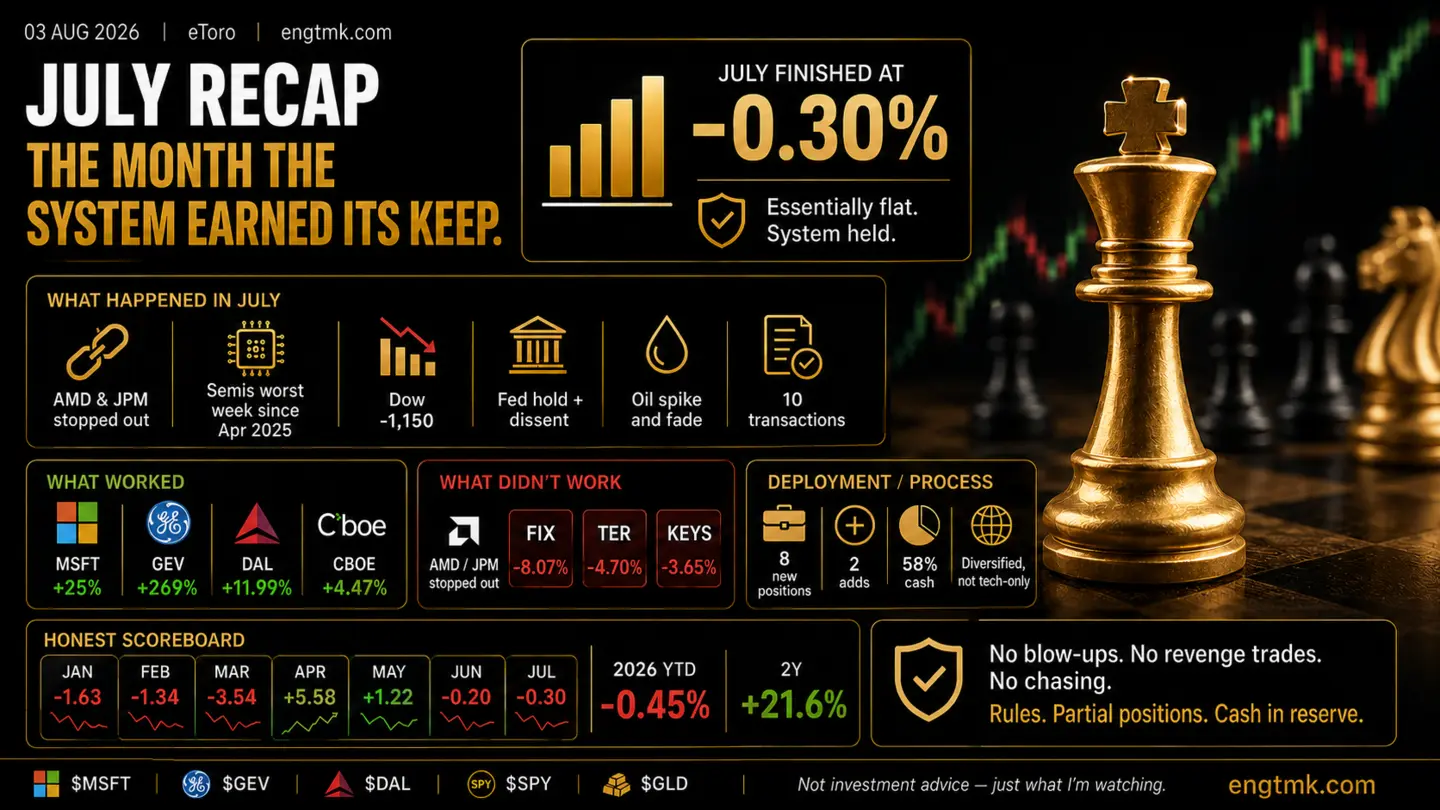
The honest scoreboard
The monthly record now reads:
2026 MONTHLY RETURNS
Seven months, one positive surge and six controlled declines
Account return by calendar month. Bar lengths use a common six-percentage-point scale.
Source: my account records. Returns are shown as reported for each month and are not a guarantee of future performance.
Year to date: −0.45%.
Two-year return: +21.6%.
I am not dressing that up.
2026 has been a grind. The account has spent seven months doing a great deal of work for almost no net return.
The two-year number provides useful context, but it does not excuse the current year. The YTD number deserves to remain visible because it answers a different question: what has the system produced recently?
The purpose of a public record is to hold both facts at once.
What worked
The strongest position returns at the recap snapshot included:
- Microsoft: approximately +25% from an entry around $388
- GE Vernova: +269%
- Eli Lilly: +49%
- American Express: +17%
- Delta Air Lines: +11.99%
- Cboe Global Markets: +4.47%
- Booking Holdings: +4%
Those are position returns, not July attribution.
That distinction matters.
A long-held winner can be up substantially since entry while contributing little—or even negatively—to one calendar month. A new position can be green at the snapshot without having driven the account’s result.
The list shows which holdings are working over their holding periods. It does not prove why July finished near flat.
Microsoft did provide a clean example of the process meeting new evidence. The position was opened around $388. Its earnings report later showed Azure growth above guidance, and the market repriced the shares sharply higher.
I did not own it because I predicted that report.
I owned it because the position had already qualified.
The earnings result strengthened the evidence after entry. It did not travel backward and create the original decision. That is the distinction in Lesson 21: A winning trade does not prove a good decision.
What did not work
AMD and JPM stopped out.
Several July entries remained underwater at the recap snapshot:
- Comfort Systems: −8.07%
- Teradyne: −4.70%
- Keysight Technologies: −3.65%
- Jabil: −3.57%
- Freeport-McMoRan: −1.78%
- Amphenol: −0.29%
This is not hidden below the winners because it is less flattering.
It is part of the same record.
Teradyne also shows why a snapshot must not be confused with a finished trade. It initially moved lower, later rose after earnings, and was still down at this measurement point. The position remains open. The final outcome is unknown.
The useful question is not whether every entry became profitable immediately.
It is whether the position size, thesis and invalidation were designed to survive an ordinary adverse move without forcing an unscheduled decision.
The July deployment
The scheduled cycle produced eight new positions:
APH, CBOE, DAL, FCX, FIX, JBL, KEYS and TER.
It also added to GLD and SPY.
Here is the complete deployment—not only the green part:
ALL TEN TRANSACTIONS
July deployment returns at the recap snapshot
Partial positions bought during a falling market were expected to begin at different speeds.
Source: my account records at the 3 August recap snapshot. These are open-position returns, not realised results or July attribution.
Seven of the ten transactions were underwater.
One was up nearly 12%.
That spread is not an accident to be explained away. It is what a portfolio of different businesses can look like shortly after deployment.
But ticker count alone does not prove diversification.
APH, FIX, JBL, KEYS and TER still share exposure to infrastructure, electronics, automation or the capital-spending cycle. Their businesses are different, but their economic drivers can overlap.
CBOE, DAL, FCX, GLD and SPY add other forces: volatility, travel demand, metals, macro hedging and broad-market exposure.
The deployment reduced dependence on one mega-cap technology narrative. It did not eliminate correlation.
That is the subject of a later lesson in the new Portfolio Architecture series: diversification is not a position count.
One portfolio, two engines
The account combines two decision engines.
One seeks momentum and breakouts: evidence that price and business strength are being rewarded now.
The other seeks quality at a better price: durable companies entering levels where expected return becomes more attractive.
They do not need to agree on every security or every month.
A momentum process can participate when leadership is persistent. A quality/value process can become more active when selloffs improve entry prices. Each has regimes in which it will look early, late or inactive.
The objective is not to make every month positive.
It is to avoid requiring one market regime to do all the work.
The full architecture is explained in Lesson 23: One portfolio, two engines.
July is one live example, not proof.
One month cannot establish that combining the engines improves risk-adjusted returns. That requires a longer record, clean sleeve-level attribution and evidence across different regimes.
What July does show is narrower and still useful: the portfolio could absorb stop-outs, uneven new entries and violent headline risk without becoming dependent on a single decision.
Cash was part of the architecture
Cash remained around 58%.
That is not a forecast that August must fall.
It is retained capacity.
The July positions were opened at partial size, so the system did not need to identify the exact low. If prices move lower and the setups remain valid, the account can add without first liquidating something else. If the market rises away from the marked levels, the cash remains available for the next scheduled opportunity.
There is a cost.
Cash can drag returns in a rising market.
Calling it “optionality” does not make that cost disappear.
The question is whether the flexibility and drawdown control are worth the foregone exposure under the portfolio’s actual rules. That must be evaluated over time, not assumed because cash feels safe.
What July did—and did not—prove
July did not prove that the system has an edge.
It did not prove that the new entries will recover.
It did not prove that 58% cash is the optimal allocation.
It did not turn a negative month into a positive one through better language.
It showed that:
- Stop-outs remained ordinary events.
- Ten transactions did not become one oversized bet.
- Partial entries allowed price to move against positions without creating urgency.
- The portfolio retained cash after deployment.
- The operating process survived a concentrated week of earnings, rates and geopolitical volatility.
- The public record remained honest about both winners and losers.
Those are process observations.
Returns decide whether the architecture is economically useful over the full sample.
Both levels of evidence matter.
August starts with the system intact
The July cycle is complete.
I am not rerunning the monthly process simply because the calendar turned to August. The next scheduled refresh remains the next decision point.
Until then:
Cash ready.
Levels marked.
Positions held under their existing rules.
No revenge trades.
No chasing.
No requirement that every new position work immediately.
July finished down 0.30%.
The system did not make the loss disappear.
It kept a small loss from becoming a reason to abandon the process.
That is the month the system earned its keep.
This is a record of my process and opinions, not investment advice. I hold positions in securities mentioned or related. Copy trading involves risk, including loss of capital. Past performance is not an indication of future results.
Like the reasoning? Every trade goes live on my eToro profile first. Copy trading involves risk of capital loss.
Copy on eToro