
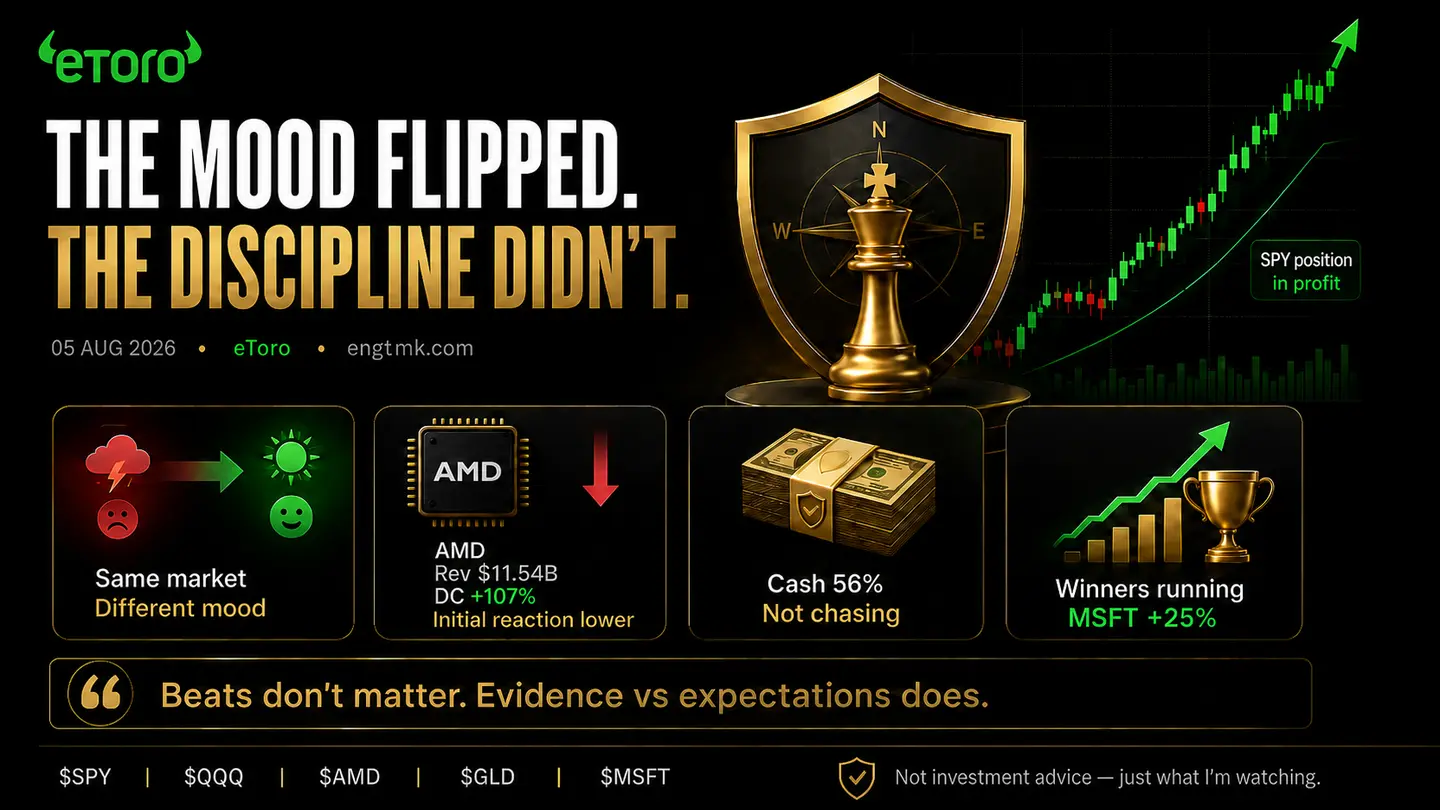
The mood flipped. The discipline did not.
The mood flipped completely.
The discipline did not.
Two weeks ago, I was writing about a semiconductor rout, two stopped-out trades and a 1,152-point Dow decline.
On Tuesday, the S&P 500 and the Dow closed at records.
Same market.
Completely different mood.
That contrast is useful because it exposes a mistake traders make in both directions.
During a selloff, price weakness begins to feel like proof that everything is broken.
At record highs, price strength begins to feel like proof that every risk has disappeared.
Neither conclusion follows from the mood.
The reversal was real
On 29 July, the Dow fell 1,152 points as investors absorbed a hawkishly divided Federal Reserve, rising yields and another technology selloff.
Less than a week later, the market was setting records.
On Tuesday, 4 August:
- The S&P 500 rose 1.79% to a record 7,736.52.
- The Dow gained 907 points, or 1.71%, to a record 54,085.88.
- The Nasdaq advanced 2.59%.
- The Philadelphia Semiconductor Index jumped 6.6% after falling 20.6% during July.
- Crude oil dropped about 5% as hopes for progress in the Iran conflict reduced part of the geopolitical premium.
Strong earnings from AI-linked companies brought buyers back. Falling oil and Treasury yields reduced some of the pressure that had hurt expensive growth stocks.
The market did not slowly reconsider.
It changed its mind at speed.
SEVEN DAYS OF NARRATIVE RISK
Fear, relief and a record—without a change in process
The headlines reversed faster than a long-horizon portfolio should.
Hawkish Fed dissents, yields and technology weakness made the market feel broken.
AI-linked earnings and lower oil helped produce a record close. Semiconductors gained 6.6%.
Record operating results still failed the expectations test as investors demanded a faster AI payoff.
Sources: Reuters, 4 August and Reuters, 5 August. AMD reflects the intraday reaction at publication time.
This is why mood is not a portfolio state.
“Fear” does not authorize a sale.
“Relief” does not authorize a purchase.
Price can change the opportunity.
New information can change the thesis.
Emotion describes neither one precisely enough.
The oil pressure eased—but did not disappear
The geopolitical story also requires precision.
Oil fell sharply on Tuesday as hopes for diplomatic progress increased.
On Wednesday, Brent moved back above $80 after the Houthis said they had attacked a Saudi tanker and Iran denied that peace talks were under way.
The immediate geopolitical premium has unwound substantially from July’s spike above $100.
The underlying risk has not vanished.
That difference matters.
Markets often move before uncertainty is resolved. They price a change in probability, not the arrival of certainty.
The fall in oil reduced near-term inflation and rate pressure.
It did not make the Strait of Hormuz, shipping risk or the Iran conflict irrelevant.
The market mood improved because the expected path improved.
It did not improve because the future became known.
AMD reported an objectively strong quarter
AMD’s second-quarter numbers were exceptional.
Revenue reached a record $11.536 billion, up 50% year over year and 13% sequentially.
Data Center revenue reached $6.7 billion, up 107%, and represented 58% of company revenue.
GAAP gross margin increased from 40% to 54%.
Non-GAAP operating income rose 245% to $3.094 billion.
Adjusted earnings reached $1.66 per share.
Management guided third-quarter revenue to approximately $13.0 billion, plus or minus $300 million. The midpoint was above the $12.52 billion analyst consensus reported by Reuters.
These were not weak results.
They were record results with faster data-centre growth, higher margins and an above-consensus revenue outlook. AMD’s Q2 release
The shares still fell more than 6% in Wednesday trading.
THE AMD EXPECTATIONS GAP
Strong operating evidence, negative price reaction
Year-over-year growth rates are compared with AMD's first full post-earnings reaction at publication time.
Sources: AMD Q2 2026 results and Reuters market reaction. The bars share a percentage scale but measure different things; they illustrate the expectation gap, not economic equivalence.
Why did AMD fall?
Because a quarterly report is judged against the expectations embedded in the price.
AMD had more than doubled during 2026 before the report.
The company had announced important customer wins and partnerships.
Investors increasingly expected AMD to become the leading alternative to Nvidia in AI accelerators.
That created a very high hurdle.
The completed quarter was good.
The forecast was above the published analyst consensus.
But investors wanted clearer evidence that the enormous AI opportunity would convert into even faster near-term growth.
Two additional details increased the pressure:
- Analysts remained concerned about supply constraints around advanced TSMC manufacturing and CoWoS packaging.
- SpaceX said it would build its computing infrastructure exclusively with Nvidia chips, adding a competitive headline on the same day.
The useful conclusion is not that results do not matter.
It is that results matter through the change they create in future expectations.
AMD’s revenue growth is evidence.
Its Data Center acceleration is evidence.
Its margin improvement is evidence.
The share price reaction says that this evidence did not exceed the market’s already elevated hurdle.
A beat is a comparison with one published estimate. A stock reaction is a comparison with the entire distribution of expectations.
Those are not the same test.
This extends the “receipts” thesis
Last week, I argued that AI spending needs receipts.
Microsoft and Amazon were rewarded because their results made the economic return from AI infrastructure easier to see.
Meta and Apple were punished because cash conversion or forward evidence disappointed.
AMD adds a refinement.
It produced strong receipts.
The market still wanted a larger one.
Receipts do not operate outside valuation.
The more success already reflected in the share price, the more evidence is required to move the expectations distribution higher.
That is why:
- A weak company can rise after a less-bad report.
- A strong company can fall after a record quarter.
- A guidance beat can disappoint.
- A revenue miss can be forgiven if margins or the future path improve.
- The same number can create different reactions at different prices.
Price does not grade the quarter in isolation.
It prices the next sequence of quarters.
I was stopped out of AMD
I owned AMD before the July semiconductor rout.
The position hit its stop and exited.
Now AMD has reported record revenue.
That does not make the stop wrong.
It also does not prove the stop was right.
The stop can only be judged against the plan and the information available when it triggered.
Its job was not to predict that AMD would never recover.
Its job was to keep the loss inside the predefined risk boundary when the trade invalidated.
A stop is not a declaration that the company is permanently bad.
It is a statement that this specific trade no longer qualifies under its existing structure.
If AMD later creates a new valid setup, the system can evaluate it as a new decision.
I do not need to hold every stock that eventually recovers.
I need losses to remain ordinary enough that no single trade can damage the process.
This is Lesson 21’s distinction between decision quality and outcome quality applied to an exit.
The future path cannot travel backward and rewrite the information set.
Record highs are not an instruction
The S&P 500’s record close is real information.
It shows broad risk appetite improved and buyers were willing to pay higher prices.
It does not say that every stock is attractive.
It does not erase the possibility of a pullback.
It does not mean cash must be deployed immediately.
A record is a location.
A setup requires more:
- A qualified company or asset
- A reason for ownership
- An entry condition
- A position size
- An invalidation rule
- A portfolio role
- Acceptable aggregate exposure
Without those elements, “new high” is only a headline.
Two weeks ago, the mood said everything was broken.
I did not panic-sell the portfolio.
Today, the mood says everything is fixed.
I am not panic-buying the index.
The discipline is symmetrical.
My portfolio today
The latest account reconciliation shows:
- 17 holdings
- Cash around 56%
- The July deployment cycle complete
- No open slots
- No new entries
- No additions
- No sales
- No executable orders
That is an important detail.
“Not chasing” is not a discretionary opinion added after the market rallied.
The current system state is HOLD — NO ACTION because the scheduled cycle is complete and no new action qualifies.
Microsoft remains roughly 25% above the original entry snapshot. GE Vernova, Eli Lilly and Delta remain among the established winners.
Newer positions are still moving through ordinary volatility at partial size.
Some are green.
Some are red.
None needs to become a market call.
Cash remains available, but it does not need to be converted into exposure because the S&P printed a record.
Lesson 22 defines this as a formal no-trade state.
The market can be active while the portfolio has nothing to do.
Diversification matters more when the mood becomes unanimous
A broad rally can make different holdings look diversified because almost everything is rising.
A selloff can reveal that several names were powered by the same economic engine.
The July deployment included APH, FIX, JBL, KEYS and TER.
They are five companies in different industries.
They also share exposure to electronics, automation, test equipment, infrastructure and the AI/data-centre capital cycle.
Five tickers are not automatically five independent bets.
That distinction is the subject of Lesson 24: Diversification is not a position count.
The lesson matters at record highs because correlation often becomes least visible when it is helping.
Different positions can rise together for one reason.
The risk appears when that reason reverses.
What changed—and what did not
What changed:
- The S&P 500 and Dow returned to records.
- Oil surrendered much of July’s geopolitical spike.
- Treasury pressure eased.
- Strong earnings restored confidence in parts of the AI trade.
- AMD added excellent operating evidence but failed its elevated expectations test.
What did not:
- My positions still require portfolio roles.
- Cash still requires a deployment rule.
- A stop still manages a trade, not a company’s permanent future.
- A record high still does not qualify an entry.
- A falling stock still does not become cheap by definition.
- A rising market still does not require an order.
The mood flipped.
The decision architecture did not.
That is the advantage of having rules before the market supplies the emotion.
Records get made and broken.
Zones do not care.
Watching.
Holding.
Patient.
The market mood is information. It is never authority.
This is a record of my process and opinions, not investment advice. I hold positions in securities mentioned or related. Copy trading involves risk, including loss of capital. Past performance is not an indication of future results.
Like the reasoning? Every trade goes live on my eToro profile first. Copy trading involves risk of capital loss.
Copy on eToro