
The economy lost jobs. Stocks went up. Here’s why that isn’t crazy.
The US economy lost jobs in July.
Stocks went up.
That sounds irrational only if the jobs report and the stock market are assumed to answer the same question.
They do not.
The jobs report describes part of the economy now.
The stock market prices expected corporate cash flows and the rate used to value them.
On Friday, the rate effect won first.
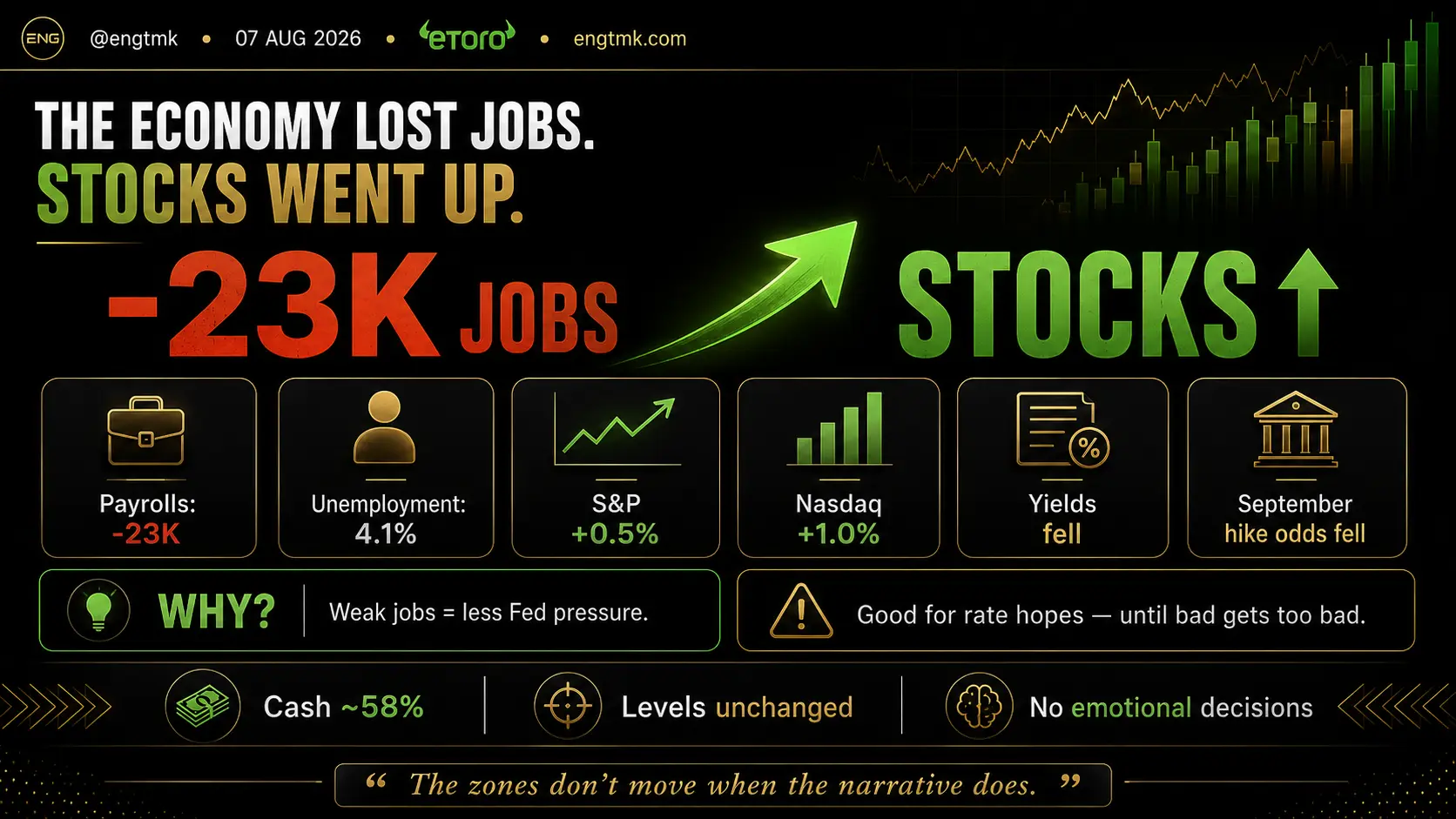
The report was weaker than the headline alone
US nonfarm payrolls fell by 23,000 in July.
Economists surveyed by Reuters had expected an increase of roughly 80,000.
The unemployment rate nevertheless edged down to 4.1%.
Those numbers are not contradictory. Payroll employment comes from a survey of businesses; the unemployment rate comes from a separate survey of households. The two measures can move differently in any one month.
The details also matter:
- Local government education employment fell by 50,000.
- Retail trade lost 19,000 jobs.
- Financial activities lost 14,000.
- Health care added 22,000.
- Average hourly earnings were little changed in July and up 3.2% over the year.
- Labour-force participation remained at 61.4%.
The more important signal may be the revision history.
May payroll growth was revised from 129,000 to 63,000. June was revised from 57,000 to 20,000.
Together, the previous two months lost 103,000 jobs from the earlier estimates.
One negative month can be noise.
A negative month combined with large downward revisions is harder to dismiss as a single bad print. Bureau of Labor Statistics
Why stocks initially rallied
The market was not celebrating job losses.
It was repricing the likely path of interest rates.
Before the report, a stronger labour market could have strengthened the case for another Federal Reserve hike. Instead, weaker payrolls reduced that pressure.
At the latest check:
- The S&P 500 was up roughly 0.5%–0.6%.
- The Nasdaq was up about 1.0%–1.1%.
- The 10-year Treasury yield had eased to around 4.65% after touching roughly 4.60%.
- Market-implied odds of a September rate increase fell to about 44% from the mid-50s before the report.
Those moves fit the discount-rate channel.
When expected rates fall, the present value of future corporate cash flows rises, all else equal. That effect is especially important for growth companies whose valuations depend heavily on profits expected years from now.
The jobs data weakened.
The expected policy path softened.
Bond yields fell.
Equity valuations received relief.
That sequence is coherent. Associated Press market update · MarketWatch rate probabilities
Gold told the same rate story through a different asset
Gold rose sharply after the report.
Spot gold was up about 2.4% near $4,342 at the latest check and was heading for a strong weekly gain.
Gold does not produce corporate earnings. Its reaction therefore came through a different set of drivers: lower yields, policy expectations, currency conditions and continued demand for macro protection.
That makes Friday a useful portfolio case study.
Stocks and gold both rose.
They did not rise for exactly the same reason, and they do not perform the same job in a portfolio.
That distinction is the subject of Lesson 25: What cash, gold and insurance actually do. Reuters gold-market report
“Bad news is good news” has a boundary
Weak economic data can help equities when it lowers rates without materially damaging expected profits.
But that relationship is not permanent.
THE INTERPRETATION CAN FLIP
The same weak data can pass through three different market regimes
What matters is which effect dominates: discount-rate relief, earnings damage or inflation constraint.
Growth cools, yields fall and earnings expectations remain broadly intact.
Lower rates cannot fully offset falling revenue, margins and profit forecasts.
Weak growth arrives while inflation prevents an easy policy response.
Friday’s market placed the report in the first category.
That judgement can change.
A few more weak labour reports could make investors lower earnings estimates faster than they lower discount rates. A renewed inflation shock could also prevent the Fed from providing the relief markets expect.
That is the line inside the phrase:
Bad news is good news only until the bad news becomes too bad.
The next question is inflation
The jobs report changed one side of the Fed’s problem.
It did not resolve the other.
The central bank is balancing a softer labour market against inflation that remains sensitive to energy, wages and supply conditions.
The next inflation report therefore matters because it will test whether weaker employment is arriving with enough price relief to make policy easier.
If inflation cools, the market can keep emphasizing lower-rate relief.
If inflation remains firm while employment weakens, the interpretation becomes less comfortable.
The market does not react to a number in isolation.
It reacts to the number’s effect on the entire expected path.
What changed in my portfolio
No unscheduled portfolio action was authorized by Friday’s headlines.
Cash remains around 58%.
The July deployment remains in place.
The marked levels remain unchanged.
That does not mean the jobs report was irrelevant.
It means information and instruction are different categories.
The report changed the market’s estimate of policy risk.
It may eventually change earnings expectations.
It did not independently qualify a new company, create a valid entry or alter an existing invalidation level.
Two weeks ago, the market supplied a rout.
This week, it supplied records.
Friday, it rallied on negative payroll growth.
Three narratives.
One decision architecture.
Cash preserves the ability to act later. Gold supplies a different macro exposure. Existing positions continue to perform their assigned portfolio roles.
None of those jobs changes because the market found a new story at 8:30 a.m.
The larger lesson
Markets are not machines that label every economic release “good” or “bad.”
They are auctions comparing new information with the future already priced in.
On Friday, the immediate benefit of lower expected rates outweighed the early evidence of weaker labour demand.
That was not crazy.
It was conditional.
The condition is that earnings remain resilient enough for the discount-rate benefit to matter.
If that condition breaks, the same kind of jobs report can produce the opposite reaction.
The narrative can move quickly because the balance between rates and earnings can move quickly.
The process should move only when its own conditions change.
The zones do not move when the narrative does.
Weekend is for reading, reviewing and preparing—not reacting.
This is a record of my process and opinions, not investment advice. I hold positions in securities mentioned or related. Copy trading involves risk, including loss of capital. Past performance is not an indication of future results.