
The consumer gets tested this week
Friday’s retail-sales report was weak.
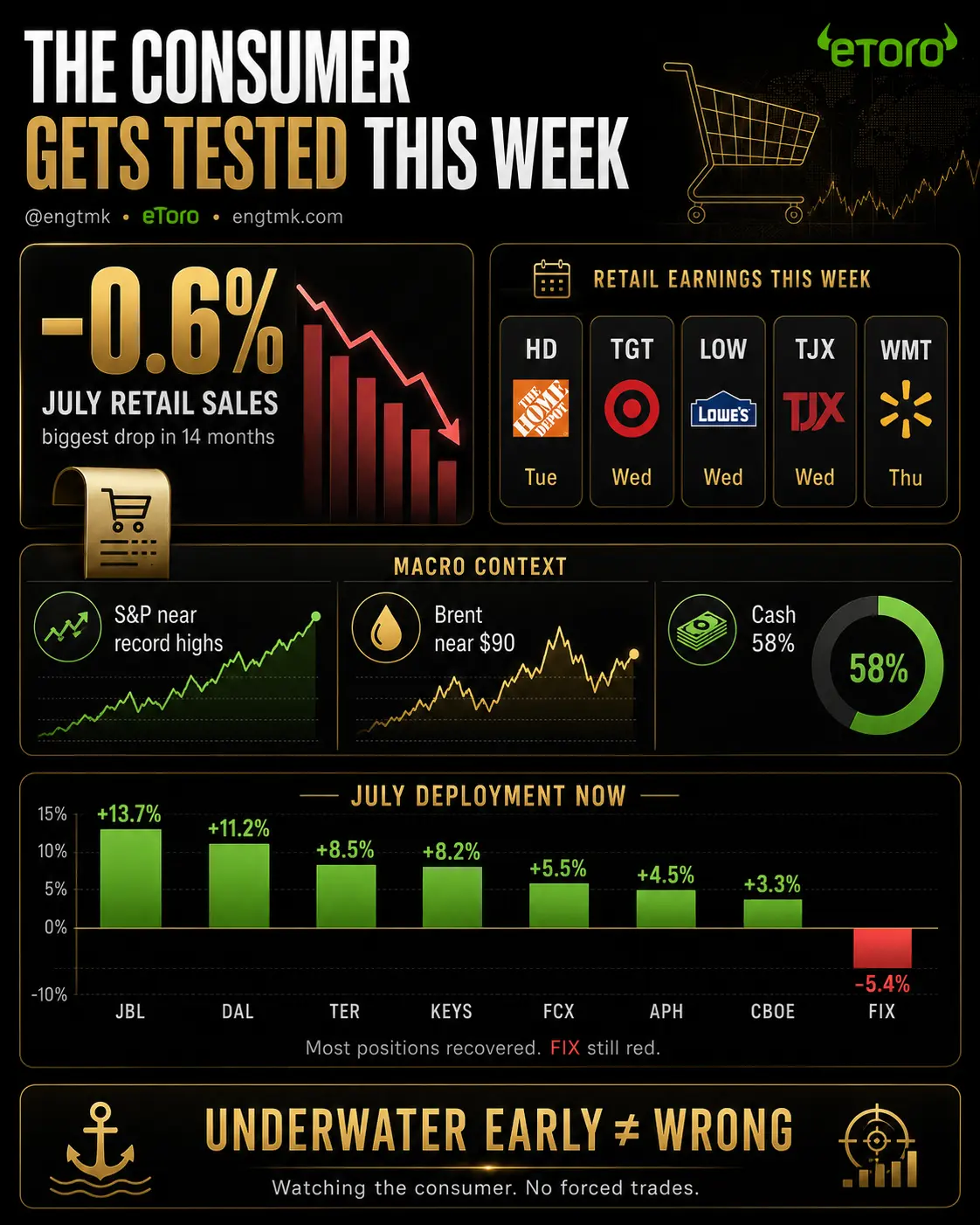
July sales fell 0.6% from June.
That was the first decline in nine months and the largest monthly drop in fourteen months.
The weakness was not confined to cheaper gasoline or slower vehicle sales.
The control group used to estimate consumer spending inside GDP also fell 0.4%.
Now the macro headline gets tested against company evidence.
- Home Depot reports Tuesday
- Target, Lowe’s and TJX report Wednesday
- Walmart reports Thursday
Five companies will not describe every American household.
But they cover enough different categories, income groups and purchasing decisions to tell us whether July was a broad consumer retreat—or a rotation between where people chose to spend.
What July retail sales actually said
The advance estimate placed July retail and food-services sales at $763.6 billion, down 0.6% from June but still 5.0% above July 2025. June’s monthly increase remained 0.2%. U.S. Census Bureau retail-sales release
The details were uneven:
- Motor-vehicle and parts dealers fell 1.8%
- Gasoline-station sales fell 0.9%
- Nonstore retailers fell 2.2%, partly affected by major promotional events moving into June
- Clothing stores rose 1.9%
- Food services and drinking places rose 0.5%
Sales excluding autos fell 0.3%.
The control group—sales excluding food services, autos, building materials and gasoline—fell 0.4%.
That last number matters because it reduces the temptation to explain the entire headline through fuel prices or cars.
The softness reached a group that feeds more directly into estimates of personal consumption.
Still, the report has limits.
It is nominal, not adjusted for inflation.
It is an advance estimate based on a sample.
It is subject to revision.
And one month cannot tell us whether consumers delayed spending, changed categories or began a sustained retreat.
That is where the company reports become useful.
Five retailers, four different consumer questions
This is not one earnings test repeated five times.
Home Depot and Lowe’s: will households fund large projects?
Home improvement sits close to housing turnover, financing costs and confidence in large discretionary purchases.
Home Depot and Lowe’s can show whether consumers are still postponing expensive projects, whether professional-contractor demand is offsetting do-it-yourself weakness, and whether average ticket or transaction volume is carrying the business.
The useful evidence includes:
- Comparable sales
- Customer transactions
- Average ticket
- Big-ticket categories
- Professional versus DIY demand
- Full-year guidance
Home Depot’s call is scheduled for Tuesday, August 18, and Lowe’s for Wednesday, August 19. Home Depot investor relations and Lowe’s investor relations
Target: is discretionary pressure broadening?
Target carries more discretionary exposure than Walmart through apparel, home goods and other categories that households can delay.
The key questions are:
- Is store and digital traffic holding?
- Are customers buying fewer discretionary items?
- Is promotional activity protecting volume at the expense of margin?
- Are inventory levels clean?
- Does management lower or maintain its outlook?
A weak Target result would not automatically describe the entire consumer.
It could show that spending is moving away from Target’s category mix.
TJX: is value-seeking becoming the winner?
TJX can benefit when shoppers remain active but become more price-sensitive.
Off-price retail has a different economic signal from full-price discretionary retail.
If TJX traffic and comparable sales remain strong while Target weakens, the conclusion would not be “the consumer is fine” or “the consumer is broken.”
It would be:
The consumer is trading down and becoming more selective.
That is a rotation in spending behaviour.
TJX is scheduled to report Wednesday, August 19. TJX reporting calendar
Walmart: the broadest basket
Walmart supplies the week’s widest view.
Its grocery business captures essential spending, while general merchandise gives insight into discretionary demand. Membership, advertising, e-commerce and marketplace results also show whether growth is coming from retail volume or higher-margin adjacent businesses.
I will focus on:
- U.S. comparable sales excluding fuel
- Grocery versus general merchandise
- Transaction growth versus average ticket
- E-commerce growth and profitability
- Advertising and membership income
- Full-year guidance
- Evidence of higher-income consumers trading down
Walmart releases results Thursday, August 20. Walmart investor relations
The three outcomes that would matter
The reports can resolve July’s weakness in several ways.
1. Broad retrenchment
Traffic, transactions and guidance weaken across home improvement, mass retail and off-price.
That would make July’s −0.6% report harder to dismiss as calendar noise or category rotation.
The market might initially welcome weaker demand as relief for rates.
But the interpretation would eventually move toward earnings risk.
2. Value rotation
Walmart and TJX remain strong while Target and the home-improvement names struggle.
That would suggest consumers are still spending but are prioritising essentials, discounts and smaller commitments.
The aggregate consumer could remain resilient while individual business models experience very different conditions.
3. July was unusually soft
Traffic, comparable sales and forward guidance remain stable across most of the group.
That would support the view that the retail-sales decline was affected by timing, falling gasoline receipts and promotional-calendar distortions more than by a durable spending break.
None of those outcomes can be inferred from a single EPS beat.
The evidence must come from revenue composition, transactions, margins and guidance.
Oil is the live complication
The consumer test is arriving as energy risk begins rising again.
Brent crude traded near $89 on Monday after tanker attacks, stalled U.S.–Iran diplomacy and sharply reduced traffic through the Strait of Hormuz restored a geopolitical premium. Reuters oil update
The chain is familiar:
Higher energy costs → more inflation pressure → firmer yields → tighter household budgets and lower valuation tolerance
But the transmission is not immediate or mechanical.
Last week’s CPI report showed exactly why. Crude had spiked during July, yet seasonally adjusted gasoline prices still fell during the month.
Oil is therefore a risk input—not a forecast of the next CPI print.
For retailers, the nearer-term questions may be more direct:
- Does fuel reduce discretionary cash flow?
- Do freight and logistics costs rise?
- Can companies protect margins without raising prices?
- Does higher uncertainty weaken large purchases?
The calls this week may tell us more about those behaviours than another broad macro headline.
Markets are not positioned for obvious distress
The S&P 500 ended Friday at 7,785.76, only 0.4% below Thursday’s record close, and gained 0.4% for the week.
The Russell 2000 rose 1.1% for the week and finished Friday at a record 3,068.42. Friday market close
That matters for interpretation.
Weak retail evidence is arriving into a market that has already priced substantial resilience.
If the five companies confirm healthy demand, the market may view July as temporary weakness.
If they point toward broader retrenchment, the surprise could matter more because the major indexes are near records and volatility remains subdued.
The same result has a different price impact depending on the expectation it meets.
The July deployment, three weeks later
Three weeks ago, most of the July deployment was underwater.
The latest account snapshot now shows:
| Position | Return |
|---|---|
| JBL | +13.7% |
| DAL | +11.2% |
| TER | +8.5% |
| KEYS | +8.2% |
| FCX | +5.5% |
| APH | +4.5% |
| CBOE | +3.3% |
| FIX | −5.4% |
The recovery is welcome.
It is not proof that every entry was correct.
The earlier drawdowns were not proof that the process was wrong either.
What mattered operationally was that the positions were partial size and the portfolio retained enough cash to let each thesis develop without demanding an immediate repair.
I did not spend three weeks averaging down, panic-exiting or constantly reshuffling the deployment.
The system did not require those actions.
This distinction is important:
Underwater early is not the same as invalidated. Positive later is not the same as validated.
The decision remains governed by the original thesis, risk limit and invalidation condition—not by the colour currently displayed beside the ticker.
Walmart is an event-risk decision, not a forecast
I also hold Walmart, roughly flat in the latest snapshot.
It reports Thursday.
I am not adding, reducing or trading around the print merely because the date is approaching.
The position was sized with the portfolio’s broader risk capacity in mind, and its thesis is not based on predicting one quarter.
Lesson 27 explains why the earnings calendar is a risk tool rather than a prediction tool.
The calendar tells me when the range of outcomes may widen.
It does not tell me which direction the gap will choose.
What I am doing
Cash remains around 58%.
The portfolio remains held under its existing rules.
No new trade is required today.
This week’s work is observation:
- Compare transactions with average ticket
- Separate essentials from discretionary spending
- Compare full-price with off-price performance
- Watch guidance rather than only completed-quarter beats
- Track whether margins confirm or contradict the revenue story
- Update Walmart’s thesis after the full information package arrives
The objective is not to predict five earnings reactions.
It is to use five different business models to understand what the July macro number actually meant.
Opening the scorecard
This article creates a public question:
Are consumers broadly pulling back, or was July a soft month shaped by category and calendar effects?
I have added it as an open call to the new Checking the Thesis index.
After the five reports, I will score the evidence against the three outcomes defined above.
That score will include what supported the thesis, what contradicted it and what the market priced—not a rewritten version made cleaner by hindsight.
The consumer gets tested this week.
So does the thesis.
This is a record of my process and opinions, not investment advice. I hold positions in securities mentioned or related. Copy trading involves risk, including loss of capital. Past performance is not an indication of future results.