
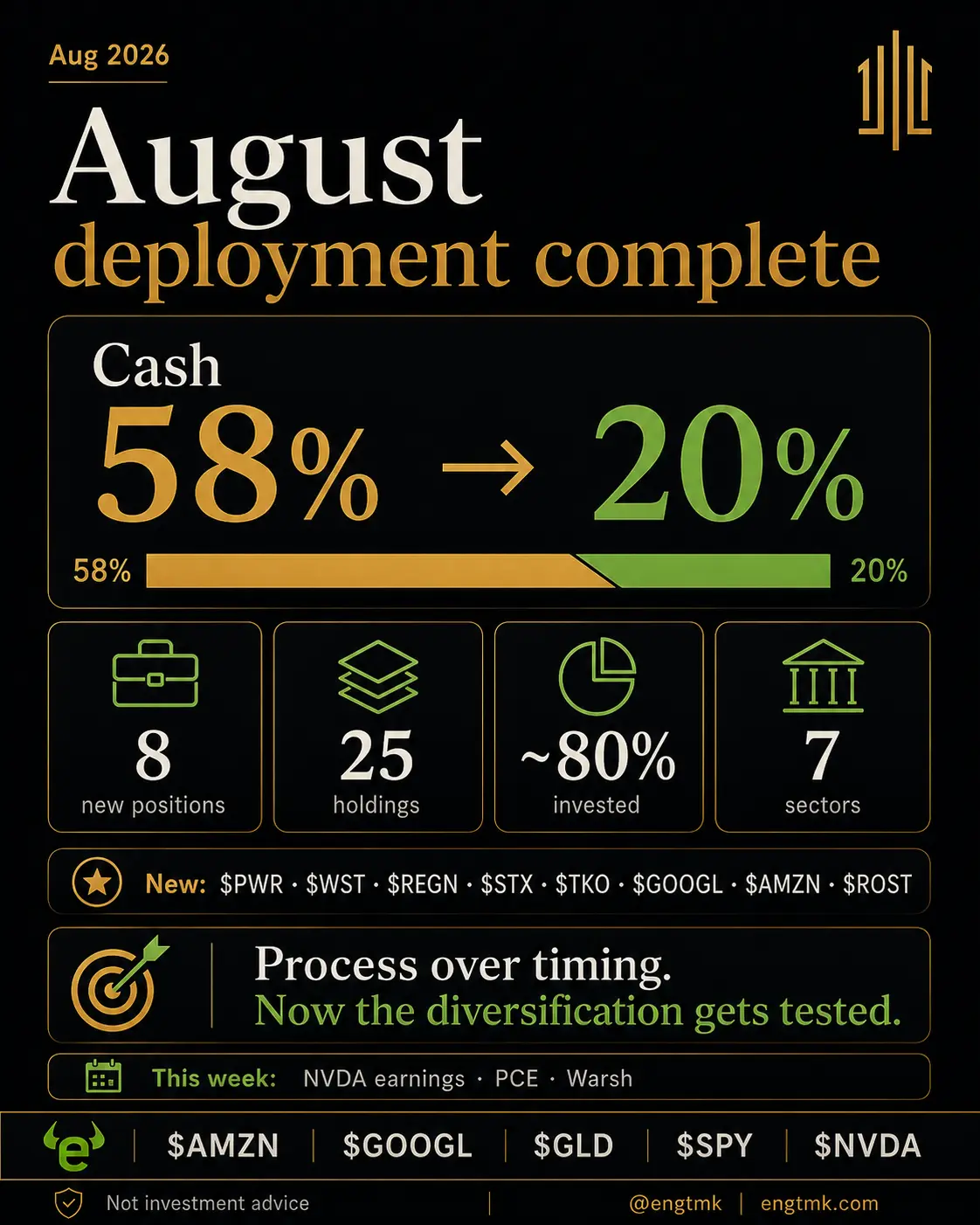
August deployment complete. Now diversification gets tested.
The August deployment cycle is complete.
I opened eight new positions:
- Quanta Services (PWR)
- West Pharmaceutical Services (WST)
- Regeneron Pharmaceuticals (REGN)
- Seagate Technology (STX)
- TKO Group (TKO)
- Alphabet (GOOGL)
- Amazon (AMZN)
- Ross Stores (ROST)
The portfolio now contains twenty-five holdings.
Cash fell from approximately 58% to 20%.
That is the most important number in the update.
For two months, a large cash reserve reduced the account’s sensitivity to market moves and preserved substantial capacity for later cycles. The August deployment has now moved the portfolio from roughly 42% invested to roughly 80% invested.
That is not a cosmetic allocation change.
It is a real increase in risk.
Why deploy near record highs?
Because the cycle completed.
I have spent weeks writing that I would not chase the index simply because it was making records. The index remains close to its highs, yet the system produced a deployment anyway.
That is not a reversal of the view.
It is the difference between a market forecast and a portfolio process.
I do not delay an otherwise qualified deployment because the broad index feels expensive, comfortable or uncomfortable. An index-level opinion does not receive an automatic veto over company-level evidence.
But scheduled does not mean price-insensitive.
The companies still had to clear the quality process, rank strongly enough for inclusion and improve the portfolio as a whole. The rule is not “buy anything when the calendar says so.”
The rule is:
When the cycle is due, execute the qualified output rather than inventing a new market-timing forecast.
Waiting solely because I hope the index will offer a more comfortable entry would be a discretionary timing decision. That is the decision the system removes.
Why these eight companies?
The common reason is not that all eight are cheap.
They are not eight versions of the same valuation argument, and I do not want to pretend that every qualifying company offers the same margin of safety.
The common filter was business quality plus a useful portfolio role.
The more helpful way to explain the selection is by the economic job each company adds—and the risk it does not diversify.
| Company | Why it qualified for the mix | Main overlap or risk |
|---|---|---|
| PWR | Quanta designs, builds and maintains power and communications infrastructure. It adds exposure to grid investment, load growth and the physical build-out behind electrification and data centres. | It is still partly an AI-infrastructure and capital-spending position, even though its official sector is Industrials. |
| WST | West supplies components and delivery systems for injectable medicines. It adds a healthcare-supplies business whose demand is tied more to drug production and quality requirements than to advertising, cloud spending or consumer confidence. | Manufacturing execution, customer concentration and pharmaceutical production cycles remain important. |
| REGN | Regeneron adds profitable biotechnology exposure across approved medicines and a broad development pipeline. Its operating outcomes can be driven by product adoption and clinical evidence rather than the next cloud-capex headline. | Product, trial, regulatory and reimbursement risk can create large company-specific moves. |
| STX | Seagate supplies mass-capacity storage used from the edge to hyperscale data centres. More AI and cloud workloads require more data to be stored, making storage a different layer of the infrastructure stack. | It is a cyclical hardware business and belongs inside the AI-capex cluster, not outside it. |
| TKO | TKO owns live sports and entertainment properties including UFC, WWE and PBR, with economics tied to media rights, sponsorship, events and fan demand. | Rights negotiations, consumer demand and media-partner economics can move together with the broader advertising and entertainment cycle. |
| GOOGL | Alphabet combines Search, YouTube and other services with a fast-growing Cloud business. It provides several monetisation engines and direct evidence of AI adoption. | It is also one of the largest AI spenders. Capital intensity, advertising demand and long-duration valuation remain shared portfolio risks. |
| AMZN | Amazon combines AWS, retail and advertising. Those engines respond to different immediate customers and give the company more than one route to operating growth. | AWS links it to AI infrastructure; retail links it to the consumer. It diversifies revenue sources inside one company, but it does not diversify the portfolio away from either theme. |
| ROST | Ross is an off-price retailer built around branded merchandise at substantial discounts to traditional department and specialty stores. It adds a value-consumer and trade-down exposure. | It still depends on discretionary spending, inventory availability and retail execution. |
The business descriptions are based on company materials from Quanta Services, West Pharmaceutical Services, Regeneron, Seagate, TKO, Alphabet, Amazon and Ross Stores.
Sector labels are not the diversification test
The portfolio now spans healthcare, industrial infrastructure, technology hardware, media, retail, large technology platforms, gold and broad-market exposure.
That sounds diversified.
It is more diversified than eight new positions in one semiconductor sub-industry.
It is not proof that the risks are independent.
Lesson 24 makes the distinction directly: diversification is not a position count.
PWR, STX, GOOGL and AMZN can all benefit from sustained investment in AI, cloud and data-centre capacity through different parts of the chain.
GOOGL and AMZN share sensitivity to AI capital spending, digital demand, yields and mega-cap valuation.
AMZN, TKO and ROST each contain a consumer or advertising channel, even though their products look very different.
WST and REGN add healthcare exposure, but both still carry policy, regulation and industry-specific risk.
SPY adds broad equity beta, but it also adds indirect exposure to companies already held directly.
GLD adds a different macro driver, but gold is diversification—not guaranteed insurance.
Seven sector labels therefore do not equal seven independent answers.
The portfolio is better described as a set of overlapping driver clusters:
| Driver cluster | New positions most exposed |
|---|---|
| AI, cloud and physical infrastructure | PWR, STX, GOOGL, AMZN |
| Healthcare products and innovation | WST, REGN |
| Consumer spending and value | AMZN, TKO, ROST |
| Advertising, media and digital engagement | GOOGL, AMZN, TKO |
| Broad equity and rate sensitivity | Most equity holdings, plus indirect exposure through SPY |
That map is less flattering than “twenty-five holdings across seven sectors.”
It is also more useful.
The sequencing is uncomfortable
Alphabet and Amazon entered the account three days before Nvidia reports.
Nvidia is scheduled to release fiscal second-quarter results on Wednesday, August 26, after the market closes. The conference call begins at 5:00 p.m. ET. Nvidia investor relations
The same morning, the Bureau of Economic Analysis releases July personal income and outlays—including the PCE inflation indexes—at 8:30 a.m. ET. The second estimate of second-quarter GDP arrives in the same slot. BEA release schedule
On Friday, Federal Reserve Chair Kevin Warsh is scheduled to deliver keynote remarks at Jackson Hole at 10:00 a.m. ET. The 2026 symposium runs August 27–29. Federal Reserve calendar, Kansas City Fed
That creates a concentrated event stack immediately after the portfolio increased its market exposure.
I did not choose the timing to express confidence in Nvidia, PCE or Warsh.
The cycle ran when it was due.
That explanation does not remove the risk. It only explains why the risk was accepted.
Lesson 27 treats the earnings calendar as a risk tool, not a prediction tool.
The calendar tells me where gap and correlation risk can arrive. It does not tell me which direction the first move will take.
What gets tested now
Not whether every new position is green after three days.
That would tell us almost nothing about selection quality.
The first test is portfolio behaviour.
When Nvidia, PCE and Jackson Hole move expectations, I want to observe:
- How much of the account moves in the same direction
- Whether the AI-infrastructure cluster behaves like one large position
- Whether healthcare and off-price retail provide genuinely different paths
- How much SPY amplifies exposures already held directly
- Whether GLD behaves as a different macro asset or joins the risk move
- Whether the remaining 20% cash provides enough capacity without creating pressure to act
The cash reserve still matters.
Twenty percent is meaningful optionality.
It is not the same shock absorber as 58%.
That needs to be said plainly because anyone following the public account is now following a substantially more invested portfolio than one month ago.
What I am doing
The August deployment is complete.
I am not adding a ninth position because Wednesday’s calendar feels important.
I am not reducing Alphabet or Amazon because their timing looks uncomfortable.
I am holding the qualified output and watching whether the intended diversification appears when it is needed.
Building the portfolio was the easy half.
The harder half is measuring whether twenty-five holdings contain enough different economic drivers—or whether several rows become one trade when the headline changes.
The standard is not:
Did I pick eight winners?
It is:
Did the deployment improve the portfolio without allowing one hidden cluster to dominate it?
That answer will take longer than three days.
Position count describes the account. Shared drivers describe the risk.
The cycle is complete.
Now the architecture gets tested.
This is a record of my process and opinions, not investment advice. I hold positions in securities mentioned or related. Copy trading involves risk, including loss of capital. Past performance is not an indication of future results.