Meta: can the cost reset turn growth into cash?
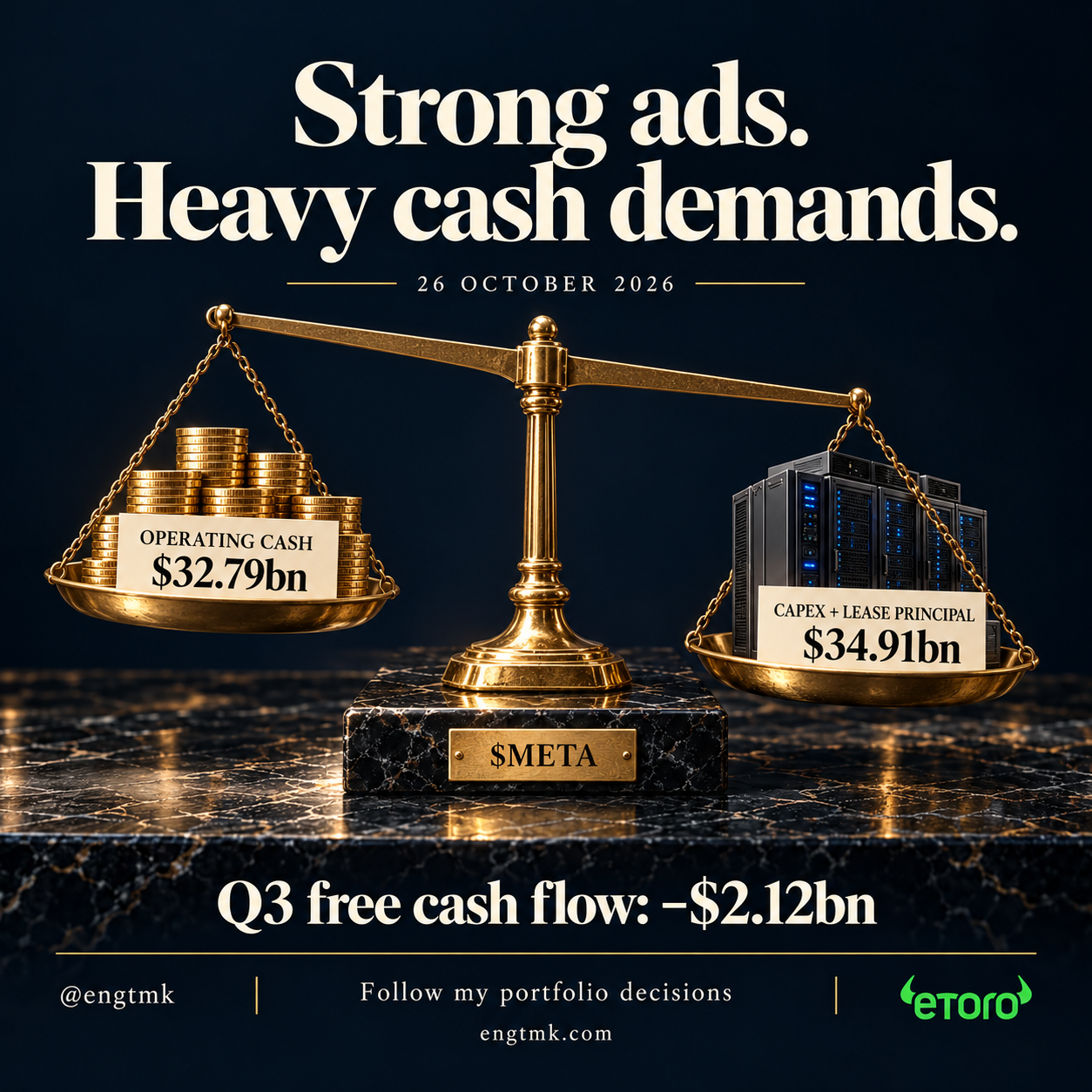
By @engtmk · Research as of 26 October 2026
After American Express, I am asking whether Meta’s cost reset can turn growth into cash. A stronger business and a stronger near-term cash return are not automatically the same thing.
Start with the cash bridge, not the headline
Meta’s 21 October results release covers the quarter ended 30 September 2026. Dollar amounts below are billions; comparisons are year on year unless stated.
| Q3 cash reconciliation | 2026 | 2025 |
|---|---|---|
| Operating cash flow | 32.786 | 29.999 |
| Property and equipment purchases | −33.942 | −18.829 |
| Finance-lease principal | −0.964 | −0.545 |
| Free cash flow, company-defined non-GAAP | −2.120 | 10.625 |
The arithmetic matters: operating cash increased $2.787bn, but the combined investment deductions increased $15.532bn. Free cash flow therefore deteriorated $12.745bn. This is not a claim that the operating business stopped generating cash.
Nor does one negative quarter prove that investment is failing. Infrastructure can support several years of earnings, while the cash leaves earlier. The risk is that the eventual returns arrive too slowly, or require more investment than anticipated. A cash-flow bridge identifies that funding test; it does not calculate an investment’s lifetime return.
Advertising provides genuine counterevidence
Revenue was $64.601bn, up 26%. Advertising impressions rose 10% and average price per ad 14%. Results release.
The earnings call, pages 4–5, attributes pricing to better ad performance and improved macroeconomic comparisons. Impression gains extended across regions; faster growth in lower-monetizing regions and surfaces partly offset pricing. Reality Labs revenue fell 6% to $443m: weaker Quest sales outweighed growth in AI glasses.
That supports a more balanced reading than either “all AI” or “all demand weakness.” Ad performance is encouraging, but management’s explanation also includes the economic backdrop and mix. The two rounded ad growth rates should not simply be added to manufacture an exact revenue reconciliation. Equally, the smaller hardware business is not evidence that the much larger advertising business is shrinking.
Removing a charge does not remove the obligation
Reported operating profit was $12.988bn, down 37%, with a 20% margin versus 40%. Adding back only the $9.890bn teen-safety legal charge gives $22.878bn, about 11.4% above last year’s $20.535bn. Release and reconciliation.
This narrower comparison is useful, but it is not a universal “underlying earnings” number. It excludes one specified item, not every expense an investor might consider unusual. Growth in that measure should not be confused with growth in free cash flow.
The 10-Q’s legal disclosures describe the teen agreement as up to $18.59bn over ten years, partly contingent, with product and compliance requirements. That maximum obligation is not the same measurement as the quarterly charge.
Separately, the filing describes the 21 October $25bn New Mexico penalty, a 15% post-judgment interest rate, an intended appeal and possible collateral requirements. It is not part of the $9.89bn charge. An appeal is not a cancellation of exposure; neither should a judgment automatically be treated as cash paid that quarter.
There is an operational response—not just an add-back
September-end headcount was 66,775, down 15% year on year. Results release.
The call, pages 5 and 8–9, identifies infrastructure, third-party AI tokens and legal costs as expense drivers. Management raised 2026 expense guidance to $175–179bn to incorporate the legal charge. It expects Reality Labs losses around $15bn in 2027, while redirecting investment primarily toward AI. The 10-Q identifies the 2026 $18–19bn Reality Labs guidance as operating losses.
The implied improvement is roughly $3–4bn, comparing forecasts with forecasts, not an achieved saving. It is an operating-loss comparison, not a cash-flow forecast. Lower headcount and a smaller segment loss are consequential operational evidence, but they do not prove that consolidated spending will fall when resources are being reallocated elsewhere.
The next tests are delivery and the 2027 budget
The call’s outlook sets Q4 revenue guidance at $73–76bn, with roughly a 1% currency headwind to year-on-year revenue growth. Full-year capex, including lease principal, is $135–145bn, previously $130–145bn. The 2027 budget remains in development.
The capex floor rises $5bn, the ceiling is unchanged, and the midpoint rises $2.5bn. That is a narrower range with a higher lower bound, not a $5bn increase at both ends. It reduces the amount of low-spending upside implicit in the previous range.
I would separate the next evidence into three scenarios:
- Stronger conversion: monetization remains resilient, the operational reset delivers, and operating cash grows faster than investment demands. That would strengthen confidence in funding future growth internally.
- Productive but cash-intensive growth: advertising stays healthy, yet infrastructure absorbs the improvement. The business could be progressing without an immediate increase in distributable cash; valuation would depend more heavily on later returns.
- Weaker economics: monetization slows while infrastructure and legal demands remain substantial. That would challenge the assumption that growth can comfortably finance the expansion.
These are tests, not forecasts. Q4 delivery and the eventual 2027 spending framework are the next observable checkpoints; I am not asserting an unverified future earnings-release date. I have not established a primary-source consensus benchmark or a timestamped share-price reaction, so this analysis makes no numerical market-reaction claim or causal claim about a sell-off. It also does not establish a fair-value multiple or disclose a new holding, weight or trade.
The TSMC analysis separated demand from margin; the AXP analysis separated reported profit from sustainable conversion. Meta adds another necessary step: whether that conversion survives the investment bill.
Can monetization and the cost reset outpace infrastructure demands—and which next result would convince you?
My portfolio and views, not investment advice.
@engtmk engtmk.com