
The Fed shows its hand. The consumer looks selective.
The Fed releases the minutes from its July meeting at 2:00 p.m. ET today.
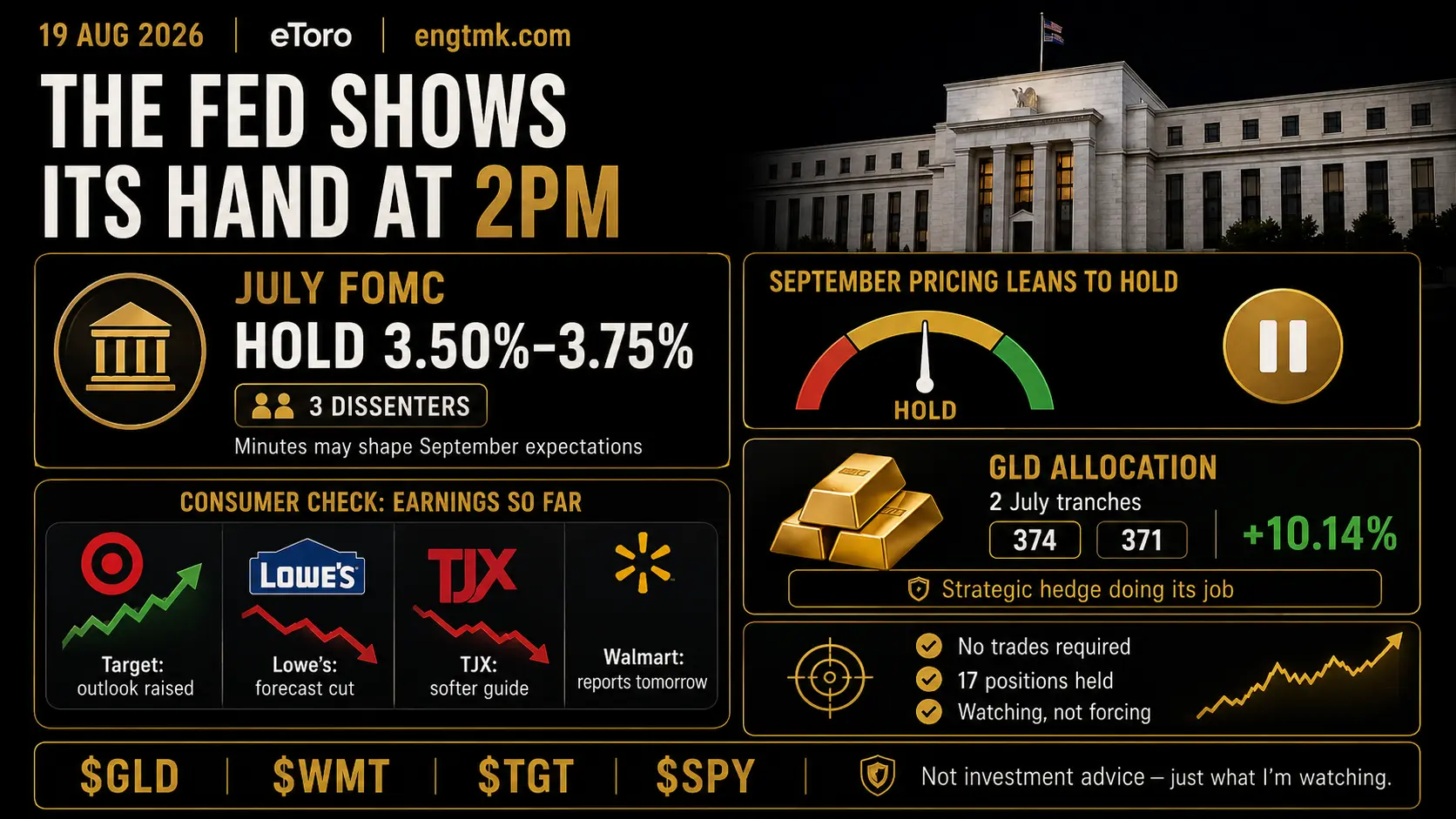
Rates were held at 3.50%–3.75%, but the decision passed by a 9–3 vote.
Beth Hammack, Neel Kashkari and Lorie Logan dissented because they preferred a quarter-point increase.
Three dissents do not make the hold decision ambiguous.
They make the discussion behind it unusually important.
The question is not simply whether three officials wanted a hike. The statement already told us that.
The useful question is whether those dissenters represented a small, clearly separated group—or the visible edge of a broader concern about inflation, energy and financial conditions.
At the same time, the consumer test I opened on Monday is producing its first evidence.
Target raised its outlook.
Lowe’s reduced its full-year sales expectations.
TJX beat its quarter and raised its full-year profit outlook, but slower growth at Marmaxx and a softer-than-expected third-quarter earnings guide weighed on the shares.
The consumer does not look broken.
It looks selective.
What the minutes can actually tell us
The Federal Reserve’s July statement said economic activity was expanding at a solid pace while inflation remained above the 2% objective, partly because of supply shocks affecting energy and other sectors.
The Committee nevertheless held the target range at 3.50%–3.75%. Federal Reserve July statement
Today’s minutes should add texture in four areas:
- How broadly officials believed current rates were restrictive enough
- How much weight they placed on softer labour data versus persistent inflation
- Whether energy and Middle East risks were treated as temporary price shocks or possible sources of persistence
- What evidence would make another increase appropriate
There is an important limitation.
Minutes are not a live policy decision.
They describe a discussion held on July 28–29, before some of the economic data markets have received since then. They also summarise a committee conversation; they do not provide a clean named tally for every argument raised around the table.
The document can reveal the Fed’s reaction function—which risks mattered and how officials weighed them.
It cannot tell us with certainty what the Committee will do in September.
That decision still has another employment report, another CPI release and several weeks of market and geopolitical developments in front of it.
Markets currently lean toward a September hold. Around two-thirds of current futures pricing supports no change.
The minutes matter because they can change the perceived threshold for a hike, not because they contain a hidden September verdict.
Three retailers, three different messages
Monday’s consumer-week setup defined three broad possibilities:
- A general consumer retrenchment
- A rotation toward value and essential spending
- A July report distorted by timing and category shifts
The evidence so far does not support a clean version of any one outcome.
It supports selectivity.
| Company | Operating evidence | What it suggests |
|---|---|---|
| Target | Comparable sales +3.8%; traffic +3.6%; digital sales +8.7%; full-year outlook raised | Consumers still respond to value, convenience and refreshed merchandise |
| Lowe’s | Comparable sales +0.2%; full-year comparable-sales outlook reduced to flat | Large home projects remain constrained by rates and weak housing turnover |
| TJX | Comparable sales +4%; adjusted EPS beat; full-year profit outlook raised | Off-price demand remains resilient, but strength varies sharply by banner |
That is more useful than asking whether the consumer is simply strong or weak.
Target: a real sales improvement with an accounting qualification
Target’s sales recovery was broad enough to matter.
Comparable sales rose 3.8%, store comparable sales increased 2.7%, and digital comparable sales grew 8.7%. The company raised its full-year sales and earnings outlook. Target Q2 results
But profit quality still needs separating from the headline.
Target recognised $994 million of tariff refunds during the quarter, adding approximately $1.65 per share to earnings. The refund is economically valuable, but it is not evidence that recurring retail operations suddenly became that much more profitable.
This is another example of the principle that appeared in Alphabet’s investment gains and other recent earnings reports:
The operating receipt and the accounting headline are not always the same number.
Target’s traffic and comparable-sales growth are the stronger evidence about the consumer.
The refund explains part of the earnings magnitude.
Lowe’s: the expensive purchase remains the weak point
Lowe’s adjusted earnings exceeded expectations, but revenue missed and comparable sales increased only 0.2%.
Management now expects full-year comparable sales to be flat, down from its previous range of flat to 2% growth. It also moved expected sales and adjusted earnings to the low end of its prior ranges. Lowe’s investor results
The pressure was concentrated where the macro backdrop would suggest:
- Large discretionary renovation projects
- Do-it-yourself spending
- Purchases connected to home turnover
Professional, online and home-services demand performed better.
That is not a consumer collapse.
It is a financing-sensitive category behaving differently from smaller, more immediate purchases.
TJX: even value retail is not uniform
TJX reported a 4% increase in consolidated comparable sales and adjusted earnings of $1.22 per share, both above plan. It raised its full-year pretax-margin and earnings guidance. TJX Q2 results
The weaker signal sat inside the result.
Marmaxx comparable growth slowed to 1%, and management’s third-quarter adjusted earnings range came in below the market’s expectation.
HomeGoods, Canada and international operations were considerably stronger.
The lesson is not merely that consumers are trading down.
It is that they are selecting by category, channel, price and urgency—even inside a retailer built around value.
Walmart is the next piece, not the final answer
Walmart reports before the market opens tomorrow.
It has the broadest basket in this week’s group: grocery and essentials, general merchandise, higher-income trade-down activity, e-commerce, advertising and membership income.
The evidence I want is not limited to whether earnings beat consensus.
I will be watching:
- U.S. comparable sales excluding fuel
- Transactions versus average ticket
- Grocery versus general merchandise
- E-commerce contribution and profitability
- Advertising and membership economics
- Full-year guidance
Walmart can clarify whether consumers are prioritising essentials and value.
It cannot turn five retailer reports into a complete census of household health.
The public consumer thesis therefore remains open, not solved early because three companies have reported.
Gold is doing a different job
GLD traded near $410 at the latest check today.
I hold two July tranches entered around $374 and $371.
The position is up roughly 10%, but that is not the reason it belongs in the portfolio.
I did not buy gold because I predicted today’s move or the wording of the Fed minutes.
It occupies a different macro exposure from the equity holdings.
Gold can respond to:
- Lower real yields
- A weaker dollar
- Geopolitical stress
- Concern about inflation or fiscal credibility
- Demand for assets outside ordinary corporate earnings risk
Today, a weaker dollar and declining bond yields supported gold while traders waited for the minutes. Spot gold rose sharply and GLD moved with it.
That does not make gold guaranteed insurance.
It can fall with equities, struggle when real yields rise, and introduce its own volatility. Its function is diversification—not certainty.
Lesson 25 explains why cash, gold and hedging are three different tools with three different jobs.
Cash provides optionality.
Gold provides a different macro exposure.
A hedge provides defined asymmetric protection at a cost.
Calling all three “safety” hides the differences that matter.
My portfolio does not require a Fed trade
I currently hold seventeen positions.
No new trade is required today.
That is not indifference to the minutes.
It is a separation between information and instruction.
The minutes may change rate expectations, yields, the dollar and equity valuations. Those are useful inputs for reviewing positions and marked levels.
They do not automatically create an entry or exit.
Walmart’s report is also known event risk. I hold the position, but I am not trading around tomorrow’s print.
Lesson 27 treats the earnings calendar as a risk tool, not a prediction tool.
The same principle applies to the Fed calendar.
Knowing when information arrives helps me control exposure.
It does not give me an edge in guessing the sentence that moves the market first.
What I am doing
The operating plan is unchanged:
- Seventeen positions held
- No trade manufactured for the 2:00 p.m. release
- Walmart held through its scheduled report at existing size
- GLD retained for its portfolio role, not because it is green today
- Consumer thesis left open until the remaining evidence arrives
The Fed minutes may tell us how broad the July hawkish concern really was.
The retailers are already telling us that household demand is uneven rather than absent.
Both are worth reading.
Neither requires forcing a trade.
Information updates the map. It does not always require moving the portfolio.
Watching, not forcing.
This is a record of my process and opinions, not investment advice. I hold positions in securities mentioned or related. Copy trading involves risk, including loss of capital. Past performance is not an indication of future results.