Three stocks. One shared risk: inside the AI investment cycle
By @engtmk · Research as of 9 September 2026
Different tickers do not automatically mean different economic exposures. Alphabet, Quanta Services and Comfort Systems USA operate different businesses, but all can be influenced by the same decision: how much customers spend expanding computing capacity and the infrastructure around it.
Google’s Finnish investment announcement makes that connection tangible. Electricity procurement, grid access and facility systems belong in the same investment discussion as chips and cloud services. A data centre produces no useful computing until those pieces work together.
My view is that reliable power can become a competitive advantage—but access to a scarce input does not, by itself, establish an attractive return for shareholders. Alphabet must monetize the capacity. Contractors must turn demand into profitable, collectible work. Investors must avoid paying a valuation that assumes exceptional conditions persist indefinitely.
This is an exposure analysis, not a claim that Quanta or Comfort Systems has won work in Finland. The public announcements reviewed here do not establish such contracts. Nor does this article rank the shares by today’s valuation: doing that requires comparable, dated market prices and earnings assumptions. The immediate research posture is to watch the operating evidence and reassess shared exposure, rather than treat three holdings as three independent bets.
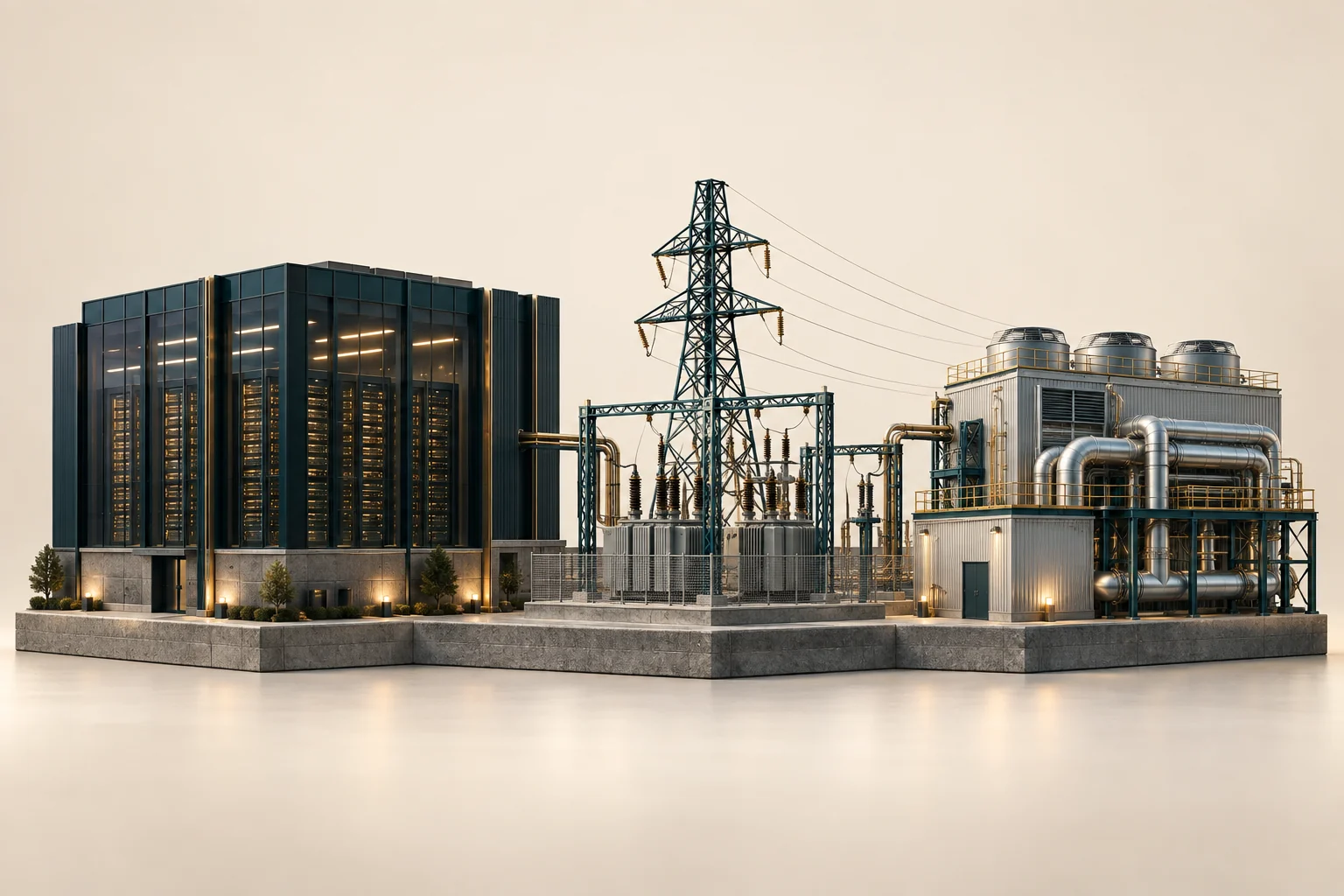
Cover: AI-generated conceptual illustration of computing, electrical and mechanical infrastructure; not actual company facilities or a contract map.
What changed in Finland
On 9 September, Google announced plans to invest at least €13 billion during 2027–2028, covering digital infrastructure and related investments and partnerships in Hamina, Kajaani, Muhos and Vaala. This is a multi-year plan, not €13 billion spent today. Google’s investment announcement.
The energy arrangements put several different functions around that expansion:
| Component | Announced arrangement | Investment significance |
|---|---|---|
| Nuclear power | A 22-year Fortum power purchase agreement; smaller capacity from 2028, reaching 50% of Loviisa’s capacity in 2030–2049 | Supports continuity of an existing source of electricity |
| Wind | Additional agreements bring total supported new-to-grid Finnish onshore wind capacity to 629 MW | Expands the renewable supply portfolio; output varies with conditions |
| Battery | A 94 MW system near Kajaani, expected operational in late 2027 | Adds flexibility to help balance the grid |
Sources: Fortum’s agreement announcement and Google’s clean-energy explanation.
The nuclear agreement concerns the life extension of the existing Loviisa plant, not delivery of a new nuclear station. Fortum says its roughly €1 billion extension programme aims to keep the plant operating through 2050; approximately €700 million of the required expenditure remained subject to investment decisions at announcement. The PPA improves revenue certainty for that programme. Fortum announcement.
The numbers also need different interpretations. The 629 MW is a supported portfolio total, not all newly announced capacity. Battery MW measures power, not storage duration: without an energy figure in MWh, 94 MW does not tell us how many hours the system can discharge. Adding wind and battery ratings would not establish continuously available power.
The new information is the scale, geography and contractual timeline of this specific commitment. It should not be treated as proof that the broader AI investment theme is new to investors, or that its beneficiaries are undervalued.
One spending decision, three financial pathways
The commercial sequence runs from a funded expansion decision through power and grid access, construction and installation, and finally productive utilization. Each stage has a different test.
| Exposure | First financial variable to watch | What creates shareholder value |
|---|---|---|
| Alphabet — GOOGL | Investment outflow, followed by utilization and operating profit | Incremental after-tax cash returns that justify the assets and commitments |
| Quanta Services — PWR | Funded project awards and the pace of backlog conversion | Profitable execution, disciplined contract terms and cash collection |
| Comfort Systems USA — FIX | Facility awards, scheduling and installation margins | Productive labour, effective procurement and profitable mechanical/electrical delivery |
This is a mechanism map, not a supplier relationship chart. Fortum is a disclosed counterparty to the Finnish announcement; PWR and FIX illustrate potential exposure to the wider infrastructure cycle.

Conceptual illustration supplied with the original post. The common base represents an economic risk factor, not identical business models or confirmed contracts between the companies.
Alphabet: securing capacity is only the first hurdle
Long-term electricity arrangements can improve planning and make a site more viable. My inference is that dependable access can help a platform deploy capacity when and where customers need it. The value depends on the complete delivered cost: generation, grid charges, balancing, resilience and the facility itself.
For Alphabet, the economic hurdle comes after procurement. Additional infrastructure must support enough profitable business to compensate for the cash invested and the risk taken. Demand growth matters, but utilization, pricing and the cost of serving workloads determine the return.
Two accounting distinctions are central. Capital expenditure consumes cash before the full cost appears in earnings through depreciation. And reported asset lives do not eliminate technological replacement risk. A facility may remain useful while some of its computing equipment becomes economically obsolete much sooner.
A spending slowdown therefore has two possible meanings. Better efficiency could allow Alphabet to meet demand with less incremental capital, improving cash generation. Weaker customer demand could also reduce spending, while damaging the longer-term growth case. The same near-term free-cash-flow improvement could accompany very different business outcomes.
The practical test is whether operating cash generation and incremental profit catch up with the investment programme over time. A long power agreement provides planning visibility; it does not guarantee profitable utilization.
Quanta: the grid opportunity must become funded work
Quanta’s role is infrastructure delivery. The relevant exposure is construction and related services, rather than selling electricity from a generation portfolio.
The transmission mechanism is conditional: higher expected electricity demand can encourage grid and customer investment; approved projects can become awards; execution can then generate revenue and profit. Announced spending is several steps away from earnings.
A growing backlog can improve visibility, but investors still need to understand its timing, scope and profitability. Work scheduled years ahead cannot automatically protect the next quarter. Changes in customer schedules can delay recognition, and cost overruns can reduce the value of a large contract.
I would examine whether growth comes from organic demand, acquisitions or a changing project mix. Those routes can produce the same headline revenue increase with different integration demands and returns on capital.
The strongest version of the case is that Quanta benefits from infrastructure needs extending beyond AI, while retaining discipline as the opportunity expands. The weak version is that investors capitalize a temporary construction surge as if unusually strong growth and margins were permanent.
Comfort Systems: facility demand meets execution risk
Comfort Systems provides mechanical and electrical contracting services, including HVAC, plumbing, piping and controls. Cooling is an important part of the opportunity, but describing FIX as only a cooling business misses the wider work that makes facilities usable. Comfort Systems’ company description and results.
For this exposure, the key constraint can be the ability to deliver: trained workers, supervision, procurement, coordination and timely installation. A contractor can have abundant demand and still destroy value if contract pricing fails to cover the cost and complexity of execution.
Rising earnings should therefore be examined alongside cash conversion and the balance sheet. Advance billings can produce cash before associated work is completed. That cash is useful, but it comes with a future delivery obligation; it should not automatically be treated as recurring surplus available for distribution.
The investment question is whether strong conditions produce repeatable profits across a range of project outcomes. I would be more persuaded by disciplined awards and sustained cash conversion than by a larger pipeline alone.
Reported results: a baseline, not Finland revenue
The contractors’ second-quarter results show that strong demand was already translating into substantial business before the Finnish announcement.
| Company and period | Revenue | GAAP diluted EPS | Backlog at 30 June |
|---|---|---|---|
| Quanta, Q2 2026 | $9.56 billion versus $6.77 billion a year earlier | $2.96 versus $1.52 | $53.4 billion |
| Comfort Systems, Q2 2026 | $3.27 billion versus $2.17 billion | $12.53 versus $6.53 | $14.06 billion |
Sources: Quanta’s results, released 30 July 2026 and Comfort Systems’ results, released 23 July 2026. Both quarters ended 30 June. Dollar figures are US dollars.
Quanta’s backlog includes estimates under master service agreements, including estimated renewals. It is therefore broader than signed, fixed-price work; reported remaining performance obligations were $33.6 billion. Acquisitions also affect growth comparisons. Comfort Systems reported same-store backlog of $13.70 billion and quarterly operating cash flow of $1.14 billion. Its billing and deferred-revenue balances increased during the first half. That exceptional cash quarter should not be annualized without assessing working-capital timing.
These reporting periods precede the September announcement. None of the figures measures revenue from Google’s new Finnish programme. Backlog and cash flow also require each company’s definitions; they are not interchangeable measures of secured economic profit.
The shared risk can arrive at different times
An unexpected reduction in hyperscaler expansion would probably reach financial statements in stages. Equity valuations can adjust immediately to a weaker expected growth path. Contractor bookings and project schedules may respond next; recognized revenue and margins can follow later as existing work is delivered.
Alphabet’s investment outflow might decline sooner than the full revenue effect emerges. Contractors may initially remain busy, even as the work replacing their current projects becomes less attractive. That gap is why an apparently strong current quarter does not settle the forward investment debate.
The exposure is not confined to a direct order from one customer. Grid projects can depend on regional load expectations, while facility work can depend on developers and other intermediaries. Investors should follow the ultimate source of demand, not only the name on the immediate invoice.
There is also a potential valuation channel. If investors group platforms, electrical infrastructure and facility contractors into one AI growth theme, a loss of confidence could pressure all three share prices even when their next-quarter earnings respond differently. This is a conditional risk, not a claim about measured current fund flows or correlations.
Which is more attractively valued?
The announcement does not establish a valuation winner. A company can be essential to a project and still be an expensive investment.
For Alphabet, I would compare the price paid with normalized cash generation after realistic reinvestment and replacement needs. For PWR and FIX, I would test earnings under more ordinary growth, margin and working-capital conditions. Comparing a contractor’s peak earnings with a platform’s investment-depressed cash flow can produce a misleading ranking.
Three questions help make the comparison fair:
- How much growth and how many years of strong execution does the valuation require?
- How resilient are earnings and cash flow if customer investment slows?
- What return remains after dilution, acquisitions, debt obligations and necessary reinvestment?
An illustrative calculation shows why operating success alone is insufficient. Suppose earnings per share rise 20%, but the price-to-earnings multiple falls from 40 to 30. The implied share-price change is 1.20 × 30 ÷ 40 − 1 = −10%, before dividends. Those multiples are assumptions, not current quotes for any of these stocks.
Without a verified, comparable market-price and forecast dataset, I will not attach current multiples, upside percentages or price targets to this article. The required proof is a valuation that survives less generous assumptions—not simply a convincing growth narrative.
Three scenarios to test
The following are analytical scenarios, without assigned probabilities or share-price forecasts.
| Scenario | Alphabet | Quanta and Comfort Systems |
|---|---|---|
| Profitable expansion | Utilization and earnings grow enough to justify investment | Funded work converts into profitable revenue and cash |
| Expansion delayed | Capacity arrives later, or assets wait for demand; cash payback shifts outward | Awards or schedules slip; backlog conversion slows and costs may rise |
| Investment reset | Lower spending may initially support cash flow; the demand or efficiency explanation determines the longer-term effect | Replacement bookings weaken; pressure reaches revenue and margins with a lag |
A fourth possibility deserves separate attention: technology becomes more efficient, but lower costs stimulate enough usage to sustain infrastructure demand. That would weaken a simple “less computing cost means less construction” argument. The outcome depends on how customers respond, not efficiency alone.
The strongest counterargument
These are not three pure bets on the same customer or end market. Alphabet has businesses beyond selling cloud capacity, and both contractors have work beyond AI facilities. Grid modernization and other industrial requirements can persist even if one category of data-centre demand cools.
Contracts, existing backlog and different project timelines can also soften or delay the effect of a slowdown. A shared risk factor does not imply equal earnings sensitivity, perfect correlation or the disappearance of all diversification benefits.
That counterargument limits the claim; it does not remove the need to examine overlap. The useful question is how much of each investment case depends on continued exceptional spending. Three positions can diversify company-specific execution risk while retaining substantial exposure to that common assumption.
What I will monitor
| Test | Evidence that strengthens the case | Evidence that calls for reassessment |
|---|---|---|
| Alphabet investment returns | Earnings and recurring cash generation improve as capacity becomes productive | Investment keeps rising while payback repeatedly moves further away |
| Power and deployment | Contract milestones and facility schedules translate into usable capacity | Connection, construction or commissioning delays |
| Quanta awards and delivery | Funded work converts with resilient margins and cash collection | Slower awards, deferred schedules or deteriorating project economics |
| Comfort Systems execution | Profitable growth with manageable labour and delivery demands | Margin pressure, cost overruns or cash conversion dependent on advances |
| Valuation discipline | Expected returns remain acceptable under normalized assumptions | The case requires peak growth and margins to persist |
| Portfolio overlap | Independent earnings drivers provide meaningful resilience | Several holdings rely on the same expansion assumptions |
The next company reporting cycles can update the operating baseline; the Finnish milestones span years. I would not judge a 2030 power ramp by one quarter’s share-price movement.
For a new investment, my posture is watchlist and wait for proof on valuation. For an existing holding, the research task is to re-underwrite the shared spending assumption alongside its individual thesis. Position sizes or trade instructions require current holdings, entry prices and risk constraints; none is prescribed here.
My investment conclusion
Reliable power is becoming part of the competitive discussion around AI. But securing electricity, building a connection and installing facility systems are different businesses, with different routes from expenditure to shareholder cash.
I want to own returns on productive investment, not merely exposure to a large budget. That means asking whether Alphabet earns enough from the capacity, whether contractors retain adequate profit while delivering it, and whether the valuation leaves room for a less favourable outcome.
This extends the earlier review of AI exposure inside a diversified portfolio: count the economic assumptions behind the positions, not only the number of tickers.
Three stocks can offer three different business models—and still share one material risk.
Sources and freshness
Research cut-off: 9 September 2026. The event facts above use Google’s investment announcement and clean-energy explanation, plus Fortum’s agreement disclosure dated that day. The financial baseline uses the dated company results linked alongside it. Company plans are forward-looking statements, not completed outcomes.
The load-bearing announcement facts are supported by primary company disclosures. Current comparable share prices, consensus forecasts, quantified portfolio sensitivities and evidence of Finnish awards to PWR or FIX are outside this article’s verified evidence set. Accordingly, this is a sourced economic-exposure analysis, not a current fair-value ranking or a forecast of contract revenue. Scenario arithmetic is explicitly illustrative.
This article presents research and opinions for education, not personalized investment advice. Investments can lose value. For the current public portfolio record, see @engtmk on eToro.