
August recap: deploying, not trading
August was a deployment month.
It was not a month of rapid trading.
There were no sells. All eight planned starter positions were filled. Six existing holdings received additional capital. Cash fell from approximately 56% to 20%.
Those facts describe a large change in portfolio exposure.
They do not yet describe a successful month.
The new positions have not been held long enough to prove the selections right, and short-term gains or losses would not settle that question anyway. What August can be judged on now is narrower: did the process allocate capital without discarding its controls when the portfolio became busier?
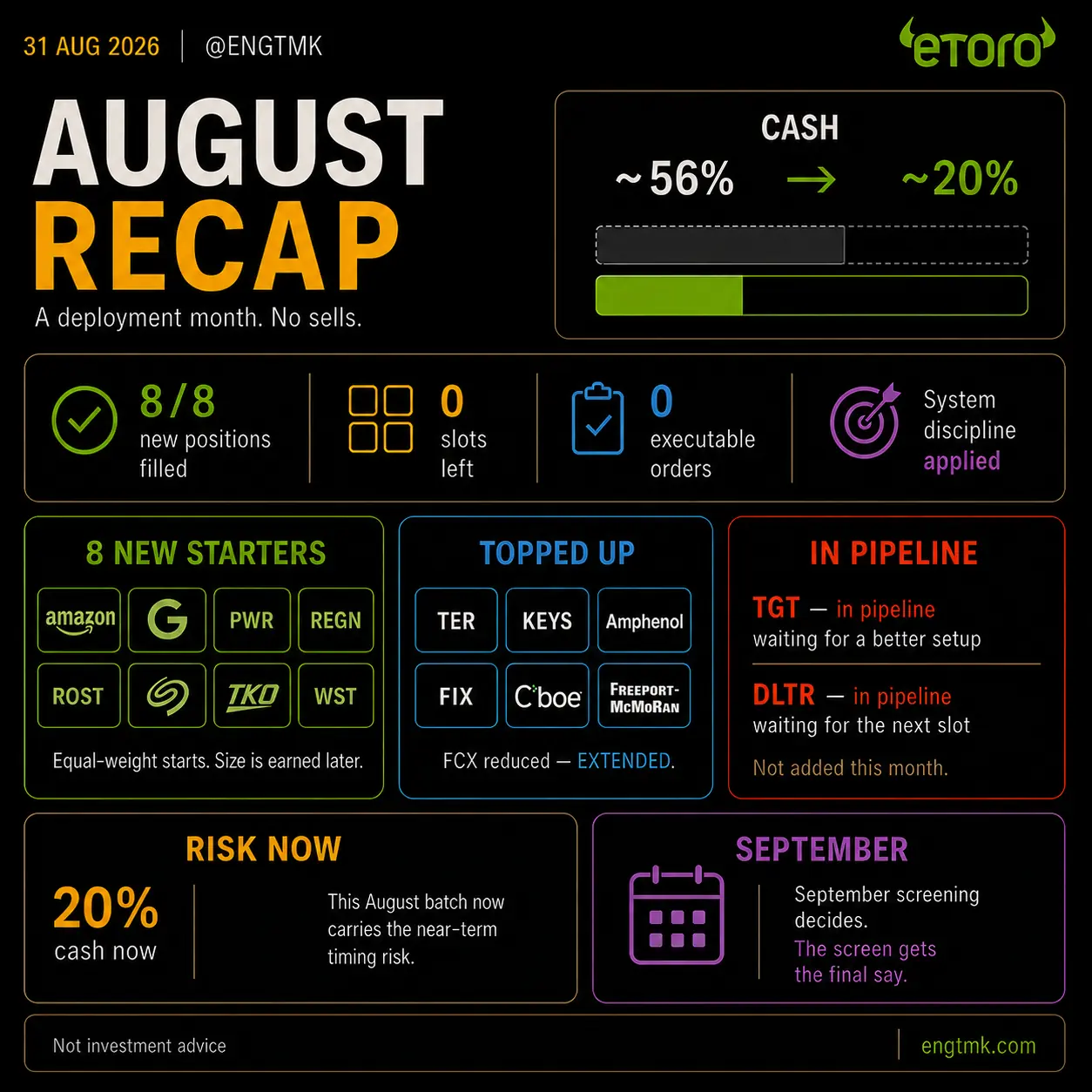
The completed August ledger
The eight new starter positions were:
- Amazon (AMZN)
- Alphabet (GOOGL)
- Quanta Services (PWR)
- Regeneron Pharmaceuticals (REGN)
- Ross Stores (ROST)
- Seagate Technology (STX)
- TKO Group (TKO)
- West Pharmaceutical Services (WST)
Each began at roughly equal weight.
Six existing positions were topped up:
- Teradyne (TER)
- Keysight Technologies (KEYS)
- Amphenol (APH)
- Cboe Global Markets (CBOE)
- Comfort Systems USA (FIX)
- Freeport-McMoRan (FCX)
No positions were sold.
At month-end, the deployment queue showed zero open slots and zero executable orders.
That is not the same as saying there were no remaining ideas. Target and Dollar Tree were still in the pipeline, but neither became an August order.
| August action | Result | What it means |
|---|---|---|
| New starters | 8 of 8 filled | The planned deployment cycle completed |
| Existing positions topped up | 6 | Additional size went to holdings already in the book |
| Sells | 0 | The month changed exposure through additions, not turnover |
| Cash | ~56% → ~20% | Market exposure and near-term cohort risk increased materially |
| Slots remaining | 0 | Portfolio capacity became an active constraint |
| Executable orders at month-end | 0 | Candidates remained, but the rules produced no order |
Equal-weight starts are a statement of uncertainty
I do not conviction-size a new idea on day one.
The screen can qualify a company for entry. It cannot prove in advance that this will become one of the portfolio’s best holdings.
Starting the eight names at roughly equal weight prevents the initial ranking from pretending to know more than it does. It limits the damage if one selection fails early, and it gives each company time to generate evidence before receiving a larger share of the risk budget.
That is what size gets earned later means.
It is not a promise that every starter will eventually be increased. Some will remain small. Some may fail their thesis or risk rules. The point is that additional size should follow evidence and a fresh portfolio decision—not the excitement of discovering a new name.
The top-ups were a separate decision
The six additions to existing holdings should not be mixed with the eight starters.
A starter answers:
Does this candidate deserve an initial place in the portfolio?
A top-up answers:
Does an existing position deserve more of the portfolio’s now-limited capacity?
Those are different decisions because the portfolio already has exposure, history and an existing risk path in the second case.
FCX shows why that distinction matters. It qualified for an addition, but the extension check classified the price as EXTENDED. The result was a smaller add rather than the full amount.
That is a useful middle state. A rule does not always need to convert a decision into a complete yes or no. It can reduce the amount of capital committed when the setup is valid but the entry has become less forgiving.
The smaller FCX add is therefore not an exception to the process. It is the process expressing less confidence through size.
Target and Dollar Tree were two different kinds of “not now”
Neither Target nor Dollar Tree entered the portfolio in August.
But they did not fail for the same reason.
Target failed the price-extension test. Its classification was EXTREME. The company may remain interesting, but the current setup did not justify entry. September begins with Target waiting for price extension to cool—not with an order waiting to be forced.
Dollar Tree remained a valid candidate. It was not added because all August slots had already been used. The limiting factor was portfolio capacity, not the candidate screen.
That difference matters for the next cycle:
| Candidate | August result | What must change |
|---|---|---|
| TGT | No entry · EXTREME extension | The price/setup must become less extended |
| DLTR | No entry · valid candidate | Portfolio capacity must become available |
Both outcomes came from rules, but one was a setup constraint and the other was a capacity constraint.
Combining them under “rejected” would remove useful information from the decision record.
Cash did not disappear; risk moved
The most important August change was not the number of trades.
It was the movement from roughly 56% cash to roughly 20%.
At the beginning of the month, more than half the account was insulated from ordinary equity-market movement. By the end, approximately four-fifths of the portfolio was invested.
That transferred risk from cash into a relatively young group of positions during one deployment cycle.
Equal weights reduce single-name concentration. They do not remove cohort timing risk.
If the market reprices growth, AI capital spending, consumer demand or interest-rate expectations, several August positions may respond at the same time. The August deployment analysis mapped those overlaps, and the later AI concentration review showed why different sector labels can still share one economic driver.
The correct description is therefore not:
Eight equal positions made the portfolio safe.
It is:
Eight equal starters limited initial single-name risk while the portfolio accepted meaningful shared timing and factor risk.
That is a less comfortable sentence.
It is also the honest one.
What August proved—and what it did not
August proved that the operating rules could still say different things when the deployment cycle was full:
- Enter eight qualified starters
- Add to six existing holdings
- Reduce the FCX add because extension had increased
- Refuse TGT because extension was extreme
- Leave DLTR in the pipeline because there was no capacity
- Stop when there were no executable orders
That is evidence of process discipline.
It is not evidence that the eight new companies will outperform.
It does not prove the diversification is real.
It does not prove 20% cash is the ideal allocation.
It does not convert an early green position into a correct thesis or an early red position into a failed one.
Diversification is not a position count, and execution quality is not the same thing as outcome quality.
The distinction is central to the public record: August can receive credit for following the allocation rules without receiving premature credit for results that have not arrived.
The September baseline
September starts with a clear, falsifiable record:
- Eight August starters, initially at roughly equal weight
- Six topped-up existing holdings
- No August sells
- Approximately 20% cash
- No unused portfolio slots at month-end
- TGT waiting for a less extended setup
- DLTR waiting for capacity
- FCX carrying a reduced add because of extension
These are the starting conditions.
The next useful evidence is not whether every position turns green in the first week. It is whether the batch begins to separate according to its business drivers, whether the intended diversifiers behave differently under pressure, and whether the remaining cash and capacity rules prevent September from becoming a forced extension of August.
The open question on the Checking the Thesis scorecard remains:
Is the portfolio genuinely diversified, or is one common factor wearing different labels?
The August recap does not close that thesis.
It gives the thesis a proper baseline.
What I am doing
Nothing needs to be forced at the start of September.
Target can remain in the pipeline until the setup improves. Dollar Tree can remain valid without receiving a slot that does not exist. The August positions can be observed without constant reshuffling.
If the batch works, the record will show it.
If it does not, the same record will show that too.
The important achievement in August was not finding eight future winners.
It was reaching the end of a large deployment without allowing urgency, extension or a full portfolio to become excuses for overriding the system.
The cycle deployed. Now the positions have to earn what comes next.
This is a record of my process and opinions, not investment advice. I hold positions in securities mentioned or related. Copy trading involves risk, including loss of capital. Past performance is not an indication of future results.