
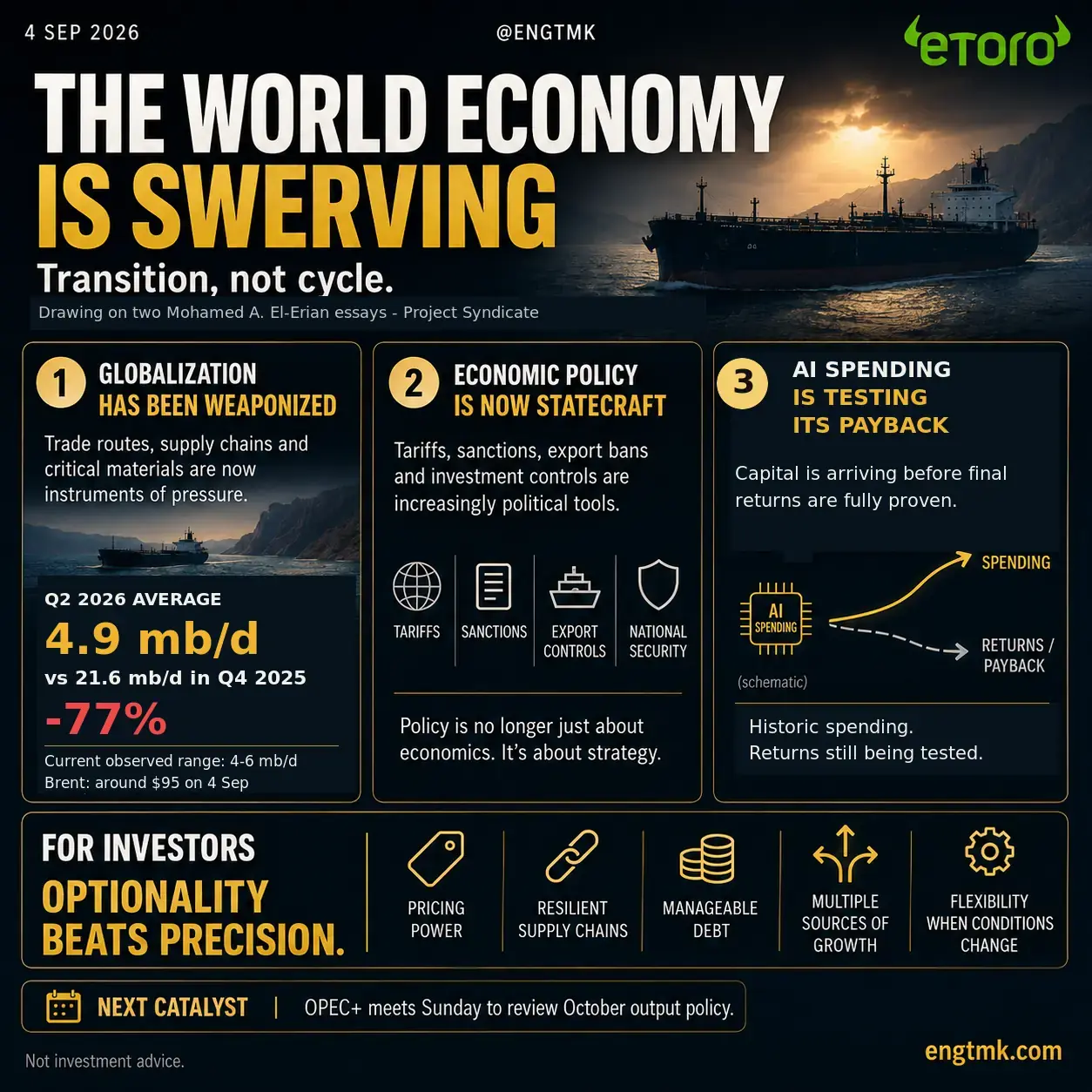
The world economy is swerving. Optionality beats precision.
Mohamed El-Erian makes a distinction that matters for investors.
The world economy may not be passing through another familiar cycle. It may be moving through a transition whose destination and operating rules are still unsettled.
A cycle encourages mean-reversion thinking: identify where the economy sits, estimate the next turn and position for a return toward normal.
A transition is less forgiving. The old relationships may weaken, policy can become part of geopolitical competition, and the eventual equilibrium may not resemble the starting point.
That does not make forecasting useless. It makes a portfolio built around one precise forecast more fragile.
My practical conclusion is simpler:
When the destination is unclear, optionality matters more than precision.
Two El-Erian arguments, not one
The starting point is El-Erian’s 10 August Project Syndicate essay, “The World Economy Is Swerving, and the Destination Is Unknown”.
Its central argument is structural. The earlier model of broadly accepted economic rules and an increasingly integrated global system has been weakened by geopolitical tension, the weaponization of economic relationships and rapid technological change.
The AI section of this analysis draws on a separate 2 September essay, “AI’s Market Path Will Get Bumpier”. El-Erian remains positive about AI’s productivity potential, but argues that the path is becoming less smooth as financing, adoption, public resistance and the consequences of the technology become more demanding.
Keeping the two sources separate matters. The first supplies the transition framework. The second shows how one of the transition’s largest capital-allocation experiments may become harder to finance and judge.
Shift one: globalization is becoming strategic
Globalization is not simply reversing.
It is being reorganized around security, leverage and political alignment.
Trade routes, critical minerals, semiconductors, energy infrastructure, payment systems and supply chains can no longer be treated as neutral pipes through which the lowest-cost solution will always flow.
The Strait of Hormuz is the live example.
The U.S. Energy Information Administration estimated that oil flows through Hormuz averaged 4.9 million barrels per day in the second quarter of 2026, compared with 21.6 million barrels per day in the fourth quarter of 2025. That is a decline of roughly 77% between those two period averages—not a real-time reading for 4 September.
The more current evidence remains severely impaired but noisy. Rystad Energy told Reuters that observed oil and product exit volumes during the war have mostly ranged from 4 million to 6 million barrels per day, apart from the brief interim agreement. Preliminary Kpler data showed only four commodity vessels crossed on Thursday, versus a recent 10-day average of about 15. Some ships may transit with tracking systems disabled, so neither vessel counts nor observed volume should be treated as perfect.
This updates the question I published on 2 September.
Physical disruption is no longer hypothetical. Flows are far below the pre-war baseline and Rystad expects them to remain low through November.
But that does not prove every rise in oil is new physical loss. One analyst quoted by Reuters said this week’s escalation had not yet materially tightened Middle Eastern exports and described the latest rally as largely fear-driven.
Both statements can be true:
- The underlying supply system is already physically impaired.
- The incremental move in price can still contain a temporary risk premium.
That distinction is more useful than forcing the market into a single label.
Shift two: economic policy is becoming statecraft
Tariffs, sanctions, export controls, investment restrictions and access to shipping or payment infrastructure increasingly serve strategic objectives.
For a company, this changes the nature of planning risk.
Management can estimate demand, costs and capacity. It has much less control over whether a government changes the rules governing a market, supplier, customer or technology.
The first-order effects are visible in revenue restrictions and higher costs. The second-order effects can be more important:
| Policy tool | Immediate corporate effect | Higher-order investor question |
|---|---|---|
| Tariff | Higher landed cost | Can the company reprice without losing volume? |
| Sanction | Lost customer, supplier or payment route | Is the exposure replaceable, and how quickly? |
| Export control | Restricted access to technology or markets | Does the product roadmap still work? |
| Investment control | Less available capital or fewer transactions | Does growth depend on cross-border funding? |
| Strategic stockpiling | Artificially stronger near-term demand | Is current revenue being pulled forward? |
This is why “resilient supply chain” should not mean merely having two factories.
It means knowing whether suppliers, logistics, financing and customer access remain usable under different political alignments.
Shift three: AI is entering a less forgiving capital phase
AI’s potential and AI capital-allocation risk are not opposites.
The technology can create enormous productivity gains while some investors and companies still earn inadequate returns on the infrastructure built to deliver them.
The relevant question is not whether AI “works.” It is who captures the economic value, on what timetable, and after how much capital has been committed.
El-Erian’s newer essay is not a declaration that the AI business case has failed. It is a warning that the unusually smooth combination of financing, market enthusiasm and expected returns is likely to become bumpier.
That makes the evidence standard higher.
I want to separate four layers:
- Usage: Is adoption expanding in real workflows?
- Revenue: Is usage producing incremental sales rather than merely engagement?
- Margin: Does the revenue survive compute, power, depreciation and distribution costs?
- Return on capital: Is the eventual cash return adequate for the amount and timing of investment?
Strong demand for chips or data centres proves demand for infrastructure. It does not automatically prove that every buyer of that infrastructure will earn an acceptable return.
The same principle appeared in the earlier AI concentration review: different sectors can share one underlying capital-spending cycle, and a broad portfolio can inherit that exposure without naming it.
What is new—and what is already known
The world did not become fragmented this week. The AI buildout did not begin this month. Hormuz has been impaired for months.
The new information is narrower:
- Current Hormuz traffic remains far below normal despite intermittent high-volume days.
- Rystad expects depressed flows to persist through November.
- Brent traded around $95 on Friday and was up more than 6% for the week at the Reuters market snapshot.
- OPEC+ is due to meet Sunday, with Reuters sources expecting October policy to remain unchanged.
- El-Erian’s latest AI argument adds financing, adoption and social resistance to the familiar capex-versus-revenue debate.
The strongest counterargument is that the market has already adapted. Alternative export routes, inventories, changing demand and higher production elsewhere can offset part of the Hormuz loss. At the same time, AI revenue growth may continue to validate the buildout faster than sceptics expect.
That counterargument is credible. It is also why I do not want the portfolio to depend on either the clean failure or the clean success of one narrative.
Sources: Reuters on 4 September Hormuz traffic, Reuters’ Friday oil-market snapshot, and Reuters’ OPEC+ meeting preview.
The investor translation
If the system is moving through a transition rather than a normal cycle, the portfolio needs attributes that remain useful across several destinations.
| Attribute | Why it matters in a transition | What would weaken it |
|---|---|---|
| Pricing power | Protects margins when inputs or trade routes reprice | Volume falls faster than prices rise |
| Supply-chain resilience | Preserves production and market access | “Diversification” still depends on one chokepoint or jurisdiction |
| Manageable debt | Reduces forced decisions when rates or funding conditions change | Near-term refinancing at much higher cost |
| Multiple growth sources | Limits dependence on one product, region or spending cycle | Different segments share the same hidden driver |
| Strategic flexibility | Allows capital, sourcing and capacity to move | Fixed commitments overwhelm cash generation |
These qualities do not immunize a stock from drawdowns. They improve the company’s ability to keep making decisions when the forecast changes.
That is the corporate version of portfolio optionality.
Scenario matrix
| Scenario | Evidence | Equity transmission | Posture |
|---|---|---|---|
| Partial normalization | Hormuz volumes recover, freight and insurance ease, OPEC+ stays steady | Energy inflation and the rate premium can fade; pressure on transport and duration assets eases | Wait for proof |
| Prolonged friction | Flows remain around the wartime range; workarounds offset some losses | Uneven margin pressure, higher logistics costs and persistent valuation volatility | Re-underwrite exposed holdings |
| Deeper structural disruption | Exports fall further, inventories draw and the oil curve tightens | Wider earnings downgrades, stickier inflation and more pressure on long-duration valuations | Reassess shared factor risk |
| AI receipts arrive | Adoption, revenue and cash returns catch up with capex | Infrastructure beneficiaries and platforms can support current investment | Hold evidence standard |
| AI payback slips | Financing costs rise while revenue and margins lag | Capex plans, suppliers and high-duration valuations reprice together | Watchlist / re-underwrite |
The next marker
OPEC+ meets Sunday to review October output policy. Reuters sources expect no change after the group completes the return of one layer of voluntary cuts in September.
An unchanged quota would not, by itself, solve the physical problem. Production targets matter only when producers can pump and move the barrels to buyers.
The next useful evidence is therefore broader than the meeting headline:
- Actual exports and loadings
- Hormuz cargo volumes, not just vessel counts
- Freight and war-risk insurance
- Inventory draws
- The prompt oil curve and refined-product spreads
- Company guidance on freight, power, input costs and demand
- AI revenue, margins and cash returns relative to investment
What I am doing
I am not building around one perfect destination.
I am checking whether each holding has the ability to adapt: pricing power, resilient supply, manageable debt, more than one source of growth and flexibility when the environment changes.
That is not a prediction that every company with those traits will win.
It is a preference for businesses—and a portfolio—that do not require the world to follow one narrow path.
In a transition with no obvious destination, optionality beats precision.
This is a record of my process and opinions, not investment advice. I hold positions in securities mentioned or related. Copy trading involves risk, including loss of capital. Past performance is not an indication of future results.